'''The cosmic microwave background''' ('''CMB''') is the faint electromagnetic radiation that fills the universe, a relic of the hot, dense, nearly uniform state in which the [[Universe|universe]] began about 13.8 billion years ago.<ref>{{#cite:Q1232}}</ref> It is the oldest light that can be observed: it was released when the universe had cooled enough to become transparent, a few hundred thousand years after the [[Big Bang theory|Big Bang]], and its photons have travelled across the universe almost undisturbed ever since. Because the expansion of the universe has stretched these photons by a factor of about 1100, the radiation is observed today not as visible light but as microwaves, forming a near-perfect blackbody at a temperature of about 2.7 kelvin.
'''The cosmic microwave background''' ('''CMB''') is a faint electromagnetic radiation that permeates the entire Universe. It is a relic of the hot, dense, and nearly uniform state in which the [[universe]] began about 13.8 billion years ago.<ref>{{#cite:Q1232}}</ref>
The CMB was predicted in the 1940s as a consequence of the hot Big Bang theory and discovered by accident in 1965 by [[Person:Arno Penzias|Arno Penzias]] and [[Person:Robert Woodrow Wilson|Robert Woodrow Wilson]], two radio astronomers at Bell Telephone Laboratories, who were awarded the 1978 Nobel Prize in Physics for the detection.<ref>{{#cite:Q1632}}</ref>
Released when the Universe had cooled enough to become transparent, a few hundred thousand years after the [[Hot Big Bang Model|Big Bang]], The CMB is the most ancient light that can be observed today from earth.
Because its spectrum and its spatial pattern can be measured with exquisite precision, the CMB has become the single most informative observable in cosmology. Its temperature is almost perfectly uniform across the sky, varying by only about one part in 100,000, and that faint pattern of hot and cold spots encodes the geometry, composition, age and history of the universe: it is the strongest evidence that the universe is spatially flat, and it anchors the measurement of the abundance of ordinary matter, [[dark matter]] and [[dark energy]].<ref>{{#cite:Q1232}}</ref>
Because of [[redshift]] caused by [[cosmic expansion]], the wavelength ($\lambda$) of the CMB is streched by a factor of about 1100. Hence, CMB observed today from earth falls into the microwave spectrum, and can be modelled as a near-perfect blackbody at a temperature of about 2.7 [[kelvin]].<ref>{{#cite:Q1634}}</ref>
With modern technologies, the spectrum and spatial pattern of the CMB can be measured with exquisite precision: It has become arguably the most informative observable in modern [[cosmology]]. Tiny variations on the scale of $10^{-5}$ provide valuable hints on the geometry, composition, age and history of the entire [[Universe]]. CMB is today the strongest evidence that the universe is spatially flat, and [[dark matter]] and [[dark energy]] dominate the Universe at present time.<ref>{{#cite:Q1232}}</ref>
== History ==
== History ==
=== Prediction ===
=== 1940s: Prediction ===
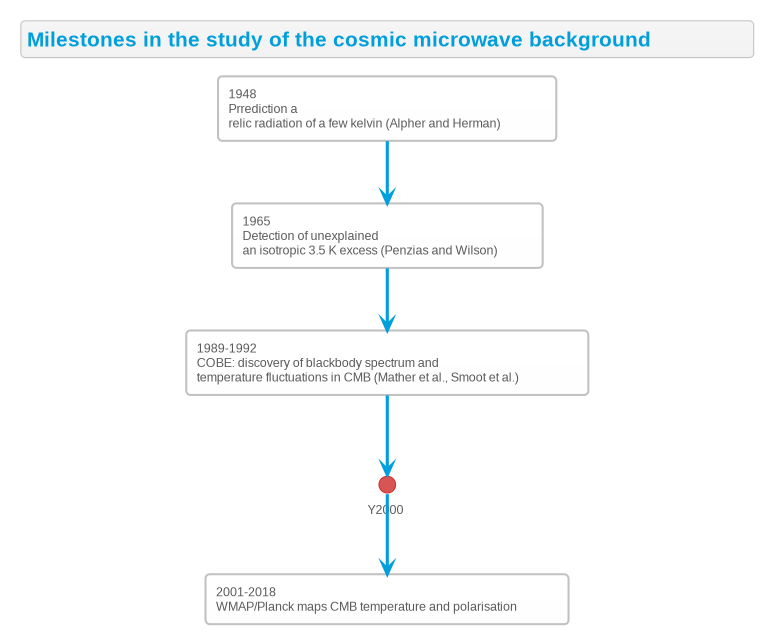
The idea that the universe began in a hot, dense state was developed in the 1940s by [[Person:George Gamow|George Gamow]] and his collaborators, who realised that a universe that was once enormously hot should still be filled with the radiation left over from that era, cooled by the expansion to a temperature of a few kelvin. In 1948, [[Person:Ralph Asher Alpher|Ralph Asher Alpher]] and [[Person:Robert Herman|Robert Herman]] estimated the temperature of this relic radiation and obtained a value of a few kelvin, remarkably close to the value measured seventeen years later.<ref>{{#cite:Q1633}}</ref> The prediction attracted little attention at the time, and the radiation was not searched for observationally.
In the 1940s, [[Person:George Gamow|George Gamow]] and collaborators demonstrated that if the Universe began in an enormously hot and dense state as suggested by the [[Hot Big Bang Model]], the [[Universe]] today should still be filled with radiation left over from that era.
The idea was independently revived in the early 1960s. [[Person:Robert H. Dicke|Robert H. Dicke]] and his group at Princeton University reasoned that the universe must be filled with a relic radiation of a few kelvin, and began building a small radiometer to look for it at a wavelength of about 3 centimetres. The detection, however, came first, and from an unexpected quarter.
[[Person:Ralph Asher Alpher|Ralph Asher Alpher]] and [[Person:Robert Herman|Robert Herman]] further estimated that taking into account the cooling provided by an expanding Universe, the temperature of this relic radiation should be only a few kelvins.<ref>{{#cite:Q1633}}</ref> The prediction attracted little attention at the time, and the observation of the radiation was not actively searched for.
=== Accidental discovery (1964–1965) ===
=== 1960s: Accidental discovery ===
[[File:Holmdel Horn Antenna.jpg|thumb|The Holmdel horn antenna at Bell Telephone Laboratories in New Jersey, with which Penzias and Wilson discovered the cosmic microwave background in 1965. Credit: Erik Dunham (CC BY-SA 3.0).]]
In the early 1960s, a group of physicists led by [[Person:Robert H. Dicke|Robert H. Dicke]] at Princeton University revisited the idea of the relic radiation and built a small radiometer to search for it.
In 1964 and 1965, [[Person:Arno Penzias|Arno Penzias]] and [[Person:Robert Woodrow Wilson|Robert Woodrow Wilson]] were using a 20-foot horn-reflector antenna in Holmdel, New Jersey, built for satellite communications, to measure the faint radio emission of the Milky Way. At a wavelength of 7.35 centimetres (a frequency of 4080 megacycles per second), they found an excess antenna temperature of about 3.5 kelvin that was isotropic, unpolarised, and present at all times of day and year, whatever part of the sky the antenna pointed at.<ref>{{#cite:Q1632}}</ref> They eliminated every source of noise they could think of, even removing a pair of pigeons that had taken up residence in the antenna throat and cleaning away the "white dielectric material" they had left behind, yet the excess remained.
Their progress, however, was ironically superseded by two telecommunication engineers who had no idea of the existence of this relic radiation.
Penzias and Wilson reported the measurement in a short paper, "A Measurement of Excess Antenna Temperature at 4080 Mc/s", published in 1965 in The Astrophysical Journal.<ref>{{#cite:Q1632}}</ref> Almost simultaneously, and in the same issue of the journal, Dicke's group published the companion paper interpreting the excess as the relic radiation of the Big Bang, which they had been about to search for. The two groups had been in contact: when Dicke heard of the Bell Labs result, he is said to have told his colleagues, "Well, boys, we've been scooped." The radiation became known as the cosmic microwave background.
[[File:Holmdel Horn Antenna.jpg|thumb|The Holmdel horn antenna at Bell Telephone Laboratories in New Jersey, with which Penzias and Wilson discovered the cosmic microwave background in 1965. Credit: Erik Dunham (CC BY-SA 3.0).]]
<blockquote>
In 1964 and 1965, [[Person:Arno Penzias|Arno Penzias]] and [[Person:Robert Woodrow Wilson|Robert Woodrow Wilson]], both doctors of philosophy in physics and working as telecommunication research engineers at Bell Telephone Laboratories, were manipulating a $6m$ horn-reflector antenna in Holmdel, New Jersey to measure the faint radio emission of the Milky Way to characterise the noise sources that would interfere with satelite communications.
[[Person:Arno Penzias|Arno Penzias]] and [[Person:Robert Woodrow Wilson|Robert Woodrow Wilson]] shared the 1978 Nobel Prize in Physics for their discovery.
</blockquote>
=== COBE: the spectrum and the fluctuations ===
For the most part, Penzias and Wilson successfully attributed detected noises to the atmosphere, human activity, and limitations of their own apparatus. However, at $\lambda = 7.35 \mathrm{cm}$ they detected a faint isotropic noise, present regardless of the antenna's orientation and time of day.<ref>{{#cite:Q1632}}</ref>
The next decisive step came with NASA's Cosmic Background Explorer (COBE) satellite, launched in November 1989, which carried three instruments designed to study the radiation. The Far-Infrared Absolute Spectrophotometer (FIRAS), led by [[Person:John C. Mather|John C. Mather]], compared the CMB with an internal blackbody calibrator and showed that its spectrum is that of a near-perfect blackbody, with no deviations detectable at the level of about one part in 10,000 of the peak brightness.<ref>{{#cite:Q1634}}</ref> The Differential Microwave Radiometer (DMR), led by [[Person:George F. Smoot|George F. Smoot]], searched for spatial variations in the temperature; in April 1992 the team announced the detection of the long-sought temperature fluctuations, at the level of about one part in 100,000.<ref>{{#cite:Q1635}}</ref>
The pair eliminated every source of noise they could think of, going as far as murdering a pair of pigeons that had taken up residence in the antenna and cleaning away the "white dielectric material" they had left behind, yet the unidentified noise remained.
The COBE results transformed the study of the CMB: the measurement of a perfect blackbody spectrum confirmed that the radiation is a relic of a hot, dense, thermalised early universe, while the detection of fluctuations showed that the early universe was not perfectly smooth, providing the seeds from which galaxies and clusters later grew. [[Person:John C. Mather|John C. Mather]] and [[Person:George F. Smoot|George F. Smoot]] shared the 2006 Nobel Prize in Physics for these measurements.
In early 1965, during a casual conversation with his friend Bernard F. Burke, a radio astronomer at MIT on an unrelated subject, Penzias was asked on his research's progress, and he mentioned the puzzling persistent noise at $\lambda=7.35 \mathrm{cm}$. Burke, who had just returned from a conference, where he heard about the attempt at Princeton to detect CMB, recognised that what Penzia had stumbled upon may actually be the elusive cosmic relic radiation that the physicists at Princeton were chasing hard behind. He immediately put Penzias in contact with Dicke, the lead scientist of the Princeton group.
=== WMAP and Planck ===
Upon visiting Holmdel, the Princeton physicists became convinced that the mysterious isotropic noise Penzias and Wilson detected with their ultra-sensitive antenna was the cosmic relic radiation that their own home-built radiometer attempted and failed to detect. The two teams agreed to coordinate the publishing of their findings. Penzias and Wilson reported the measurement in a short, deliberately understated paper, "A Measurement of Excess Antenna Temperature at 4080 Mc/s¹";<ref>{{#cite:Q1632}}</ref> the Princeton group supplied the cosmological interpretation, "Cosmic Black-Body Radiation²", which appeared immediately before it in the same issue of The Astrophysical Journal.<ref>{{#cite:Q1643}}</ref>
[[File:COBE WMAP Planck comparison (PIA16874).jpg|thumb|upright=1.6|The evolution of CMB maps: COBE (left, 1989), WMAP (centre, 2001) and Planck (right, 2009). Each generation resolved the temperature pattern with greater sensitivity. Credit: NASA/JPL-Caltech/ESA (public domain).]]
<blockquote>
1: 4080 Mc/s is the frequency corresponding to $\lambda=7.35 \mathrm{cm}$.
Two subsequent space missions mapped the CMB with far higher sensitivity and resolution. NASA's Wilkinson Microwave Anisotropy Probe (WMAP), launched in 2001, and its successor, ESA's Planck satellite, launched in 2009, measured the temperature and polarisation of the CMB across the whole sky. The final full-mission Planck results, published in 2020, determined the parameters of the standard cosmological model to percent-level precision, measuring the age of the universe at 13.787 billion years, the Hubble constant at 67.4 km s<sup>−1</sup> Mpc<sup>−1</sup>, and the tilt of the primordial fluctuation spectrum at about 0.965, all consistent with a spatially flat universe dominated by dark energy and dark matter.<ref>{{#cite:Q1232}}</ref>
2: The CMB was characterised as an excess antenna temperature/cosmic black-body radiation as the radiowaves received by the antenna Penzias and Wilson were manipulating is consistent with radiations from a $T=3.5K$ [[black body]].
</blockquote>
<uml>
<blockquote>
@startuml
[[Person:Arno Penzias|Arno Penzias]] and [[Person:Robert Woodrow Wilson|Robert Woodrow Wilson]] shared the 1978 Nobel Prize in Physics for their accidental ground-breaking discovery.
!theme bluegray
</blockquote>
title Milestones in the study of the cosmic microwave background
rectangle "1948\nAlpher and Herman predict a\nrelic radiation of a few kelvin" as Y1948
=== Since 1980s: Measuring the spectrum and the fluctuations ===
rectangle "1965\nPenzias and Wilson detect\nan isotropic 3.5 K excess" as Y1965
rectangle "1978\nNobel Prize in Physics to\nPenzias and Wilson" as Y1978
rectangle "1989–1992\nCOBE: blackbody spectrum and\ntemperature fluctuations" as YCOBE
rectangle "2000\nBOOMERanG resolves the\nfirst acoustic peak" as Y2000
rectangle "2001–2010\nWMAP maps temperature and\npolarisation" as YWMAP
rectangle "2009–2018\nPlanck: final full-mission\ncosmological parameters" as YPL
Y1948 --> Y1965 : prediction confirmed by accident
==== COBE and 2 landmark discoveries ====
Y1965 --> Y1978 : discovery recognised
Y1978 --> YCOBE : from detection to precision
YCOBE --> Y2000
Y2000 --> YWMAP
YWMAP --> YPL
note bottom of YPL
Each mission sharpens the measurement
of the same ancient radiation, tightening
the parameters of the ΛCDM model.
end note
@enduml
</uml>
== Origin and physical properties ==
=== The surface of last scattering ===
In the hot early universe, matter was ionised: free protons and electrons formed a plasma that scattered light almost continuously, so that radiation and matter were tightly coupled and the universe was opaque. As the universe expanded, it cooled, until, a few hundred thousand years after the Big Bang, its temperature had fallen to about 3000 kelvin and the free electrons combined with protons to form neutral hydrogen, in the epoch known as recombination. With the charged particles gone, the radiation was suddenly free to travel: the universe became transparent, and the photons that had been scattered for the last time began to stream freely. Those photons are the cosmic microwave background we observe today.
The region from which these photons reach us is called the surface of last scattering. It is not a physical surface but a spherical shell centred on the observer, at a redshift of about 1090, corresponding to a time when the universe was about 380,000 years old and roughly one-thousandth of its present size.<ref>{{#cite:Q1232}}</ref> Since decoupling, the expansion of the universe has stretched the wavelength of each photon by a factor of (1 + ''z''), so that the temperature of the radiation scales with redshift as
{{#content:Q1637}}
where ''T''<sub>0</sub> ≈ 2.7 K is the temperature measured today. Between emission and reception, the CMB photons have travelled almost freely, deflected only slightly by the gravity of intervening matter, an effect known as gravitational lensing.
=== A near-perfect blackbody ===
[[File:CMB spectrum (COBE FIRAS).svg|thumb|upright=1.35|The spectrum of the cosmic microwave background measured by the FIRAS instrument on COBE (points) compared with the theoretical curve of a single-temperature blackbody (solid line); the error bars are too small to be seen. Credit: plot of public-domain NASA COBE data (public domain).]]
[[File:CMB spectrum (COBE FIRAS).svg|thumb|upright=1.35|The spectrum of the cosmic microwave background measured by the FIRAS instrument on COBE (points) compared with the theoretical curve of a single-temperature blackbody (solid line); the error bars are too small to be seen. Credit: plot of public-domain NASA COBE data (public domain).]]
A blackbody is an ideal emitter that radiates purely according to its temperature. The spectrum of the cosmic microwave background matches the Planck function, the theoretical spectrum of a blackbody, to extraordinary precision: FIRAS measured it across more than a decade of the spectrum and found the data to be indistinguishable from a blackbody curve, placing tight limits on any deviation.<ref>{{#cite:Q1634}}</ref> In terms of frequency ν, the intensity of a blackbody at temperature ''T'' is given by Planck's law:
In 1989, NASA launched its Cosmic Background Explorer (COBE) satellite, equipped with 3 instruments dedicated to the study of the CMB:
{{#content:Q1636}}
* the Far-Infrared Absolute Spectrophotometer (FIRAS), designed to measure the frequency spectrum of the CMB at millimetre and submillimetre wavelengths, with a built-in internal blackbody reference for comparison with a perfect blackbody;
* the Differential Microwave Radiometer (DMR), which compared the temperature of the CMB in two beams separated by $60^\circ$, at frequencies of 31, 53 and 90 GHz to identify tiny spatial temperature fluctuations of the CMB;
* the Diffuse Infrared Background Experiment (DIRBE), which mapped the diffuse infrared background of the Universe as observed from earth, complementing the CMB measurements at shorter wavelengths.
where ''h'' is the Planck constant, ''c'' the speed of light, and ''k''<sub>B</sub> the Boltzmann constant. The temperature of the CMB monopole, the sky-averaged value of the radiation, is about 2.7 K, and its spectrum peaks at a wavelength set by Wien's displacement law:
The analysis of data collected by COBE led to two landmark conclusions.
{{#content:Q1638}}
* CMB can be modelled as radiation from a near-perfect blackbody, with deviations on the scale of $10^{-5}$, consistent with expectations for relic radiations from a hot, dense, thermalised early Universe. (Mather et al.).<ref>{{#cite:Q1634}}</ref>
* Spatial temperature fluctuations in the CMB can be detected on the scale of $10^{-5}$ from the mean temperature(Smoot et al.), consistent with the small density fluctuations required by the [[Hot Big Bang Model]] for formation of stars and galaxies via graviational interactions.<ref>{{#cite:Q1635}}</ref>
For ''T'' ≈ 2.7 K this gives a peak wavelength of roughly a millimetre, squarely in the microwave band, which is why the radiation is observed with microwave instruments.
<blockquote>
[[Person:John C. Mather|John C. Mather]] and [[Person:George F. Smoot|George F. Smoot]] shared the 2006 Nobel Prize in Physics for their landmark discoveries.
</blockquote>
That the CMB is such a precise blackbody is powerful evidence for the hot Big Bang theory. Only radiation that was once in thermal equilibrium with matter in an extremely hot, dense phase can plausibly fill the sky with a blackbody spectrum to this accuracy; steady-state cosmologies, in which the radiation would have to be produced by astrophysical sources, have no natural way of generating it.<ref>{{#cite:Q1634}}</ref>
==== WMAP and Planck ====
=== A geometric probe of the universe ===
[[File:COBE WMAP Planck comparison (PIA16874).jpg|thumb|upright=1.6|The evolution of CMB maps: COBE (left, 1989), WMAP (centre, 2001) and Planck (right, 2009). Each generation resolved the temperature pattern with greater sensitivity. Credit: NASA/JPL-Caltech/ESA (public domain).]]
[[File:Universe-timeline.jpg|thumb|upright=1.6|The history of the universe from the Big Bang to the present. The cosmic microwave background was released at recombination, a few hundred thousand years after the Big Bang (right of centre). Credit: NASA/WMAP Science Team (public domain).]]
The pattern of the CMB also makes it a precise probe of the geometry of the universe. Cosmologists describe densities in terms of the critical density, the density that would just halt the expansion of a spatially flat universe:
{{#content:Q1560}}
where ''H'' is the Hubble parameter and ''G'' the gravitational constant. The ratio of any component's density to the critical density is its density parameter, and the total density parameter of the universe is usually written ''Ω''<sub>total</sub>. The angular scale of the acoustic peaks of the CMB (described below) depends on the total density: in a positively curved universe, features would appear larger than in a flat one, and in a negatively curved universe they would appear smaller. The Planck measurements of the peaks imply a total density parameter of 1 to within a few tenths of a percent, and a curvature density parameter ''Ω''<sub>K</sub> = 0.0007 ± 0.0019: the universe is spatially flat to very high precision.<ref>{{#cite:Q1232}}</ref>
Flatness alone does not fix the composition, but the detailed shape of the CMB pattern does. Planck finds that ordinary baryonic matter contributes about 5% of the total density, dark matter about 27%, and dark energy about 68%, with the dark energy behaving like a cosmological constant.<ref>{{#cite:Q1232}}</ref> These are the values quoted in the articles on [[dark energy]] and [[dark matter]], which the CMB constrains jointly with the other cosmological probes.
== The anisotropy of the CMB ==
Two subsequent space missions, NASA's Wilkinson Microwave Anisotropy Probe (WMAP), launched in 2001, and ESA's Planck satellite, launched in 2009, mapped the temperature and polarisation of the CMB over the entire celestial sphere with far higher sensitivity and resolution than COBE, which allowed precise determinations of the age and [[dark energy]] density of the Universe.<ref>{{#cite:Q1232}}</ref>
=== The dipole ===
[[File:Planck CMB map.jpg|thumb|upright=1.6|All-sky map of the cosmic microwave background measured by ESA's Planck satellite. The colour differences are temperature fluctuations of about one part in 100,000. Credit: ESA and the Planck Collaboration (CC BY 4.0).]]
The largest apparent departure from uniformity of the CMB is a dipole: the sky is very slightly hotter in one direction and colder in the opposite one, by about one part in a thousand, a temperature difference of a few millikelvin. The dipole does not originate in the early universe but in our own motion: the Solar System is moving at a few hundred kilometres per second relative to the rest frame defined by the CMB, and the resulting Doppler shift makes the radiation slightly hotter in the direction of motion and colder behind us.<ref>{{#cite:Q1635}}</ref> Removing this dipole is the first step in analysing the CMB, and it leaves a pattern that is uniform to one part in 100,000.
=== Fluctuations of one part in 100,000 ===
After the dipole is subtracted, the CMB temperature is almost perfectly constant across the sky: the remaining fluctuations, first detected by COBE in 1992, are at the level of about 30 microkelvin, one part in 100,000 of the mean.<ref>{{#cite:Q1635}}</ref> These fluctuations are the imprint of tiny density variations present in the universe at recombination, the "seeds" from which galaxies, clusters and the large-scale structure of the cosmos later grew by gravitational instability: slightly overdense regions had slightly hotter radiation and eventually collapsed into the structures seen today.
The pattern of the fluctuations is nearly scale-invariant, meaning that patches of very different angular size have comparable amplitude, as predicted by the theory of cosmic inflation. The statistics of the pattern are described by expanding the temperature map into spherical harmonics, each labelled by a multipole ℓ that roughly corresponds to an angular scale of 180°/ℓ.
=== The angular power spectrum ===
[[File:CMB angular power spectrum (WMAP).svg|thumb|upright=1.5|The angular power spectrum of the CMB temperature anisotropies from three years of WMAP data (points) together with measurements from ground-based and balloon-borne experiments (coloured points); the solid curve is the best-fitting cosmological model. Credit: NASA/WMAP Science Team (public domain).]]
The statistical content of the fluctuations is usually summarised by the angular power spectrum, the variance of the spherical-harmonic coefficients C<sub>ℓ</sub> as a function of multipole ℓ, conventionally plotted in the dimensionless form
{{#content:Q1639}}
The power spectrum of the CMB is not flat: it shows a series of peaks and troughs, the acoustic peaks, which are among the most important measurements in cosmology. They arise because, before recombination, the photon–baryon fluid supported sound waves: gravity compressed overdense regions while radiation pressure pushed back, setting up oscillations that froze into the temperature pattern when the radiation decoupled. Modes that had completed a whole number of half-oscillations by decoupling appear as peaks in the power spectrum, and modes caught at other phases appear as troughs.
Each feature of the power spectrum carries specific information:
* the position of the first peak, at ℓ ≈ 200, is set by the angular size of the sound horizon and measures the total density of the universe, pinning down its geometry;<ref>{{#cite:Q1232}}</ref>
* the odd–even alternation in the heights of successive peaks, the pattern of compressional versus rarefactional modes, measures the baryon density, since baryons load the compressional modes;
* the overall damping of the peaks at high ℓ, caused by photons diffusing out of small regions during recombination (Silk damping), measures the matter density and the thickness of the last scattering surface;
* the plateau of power at low ℓ, the Sachs–Wolfe effect, reflects the gravitational potential fluctuations and measures the amplitude and tilt of the primordial fluctuation spectrum;
* gravitational lensing of the CMB by intervening matter slightly smooths the peaks and adds power at small scales, providing a direct measurement of the growth of structure, sensitive to dark matter.
Fitting the full spectrum together with the polarisation measurements and the lensing signal yields the parameters of the standard model of cosmology, and it is in this way that the CMB constrains the geometry, contents and age of the universe quoted above.<ref>{{#cite:Q1232}}</ref>
<uml>
<uml>
@startuml
@startuml
!theme bluegray
!theme bluegray
title What the features of the CMB angular power spectrum reveal
title Milestones in the study of the cosmic microwave background
database "Sachs–Wolfe plateau\n(low multipoles)" as SACHS
rectangle "1948\nPrrediction a\nrelic radiation of a few kelvin (Alpher and Herman)" as Y1948
database "First acoustic peak\n(position, ℓ ≈ 200)" as PEAK1
rectangle "1965\nDetection of unexplained \nan isotropic 3.5 K excess (Penzias and Wilson)" as Y1965
database "Odd–even peak height\nalternation" as ODD
rectangle "1989–1992\nCOBE: discovery of blackbody spectrum and\ntemperature fluctuations in CMB (Mather et al., Smoot et al.)" as YCOBE
database "Damping tail\n(high multipoles)" as TAIL
rectangle "2001–2018\nWMAP/Planck maps CMB temperature and polarisation" as YWMAPL
database "Gravitational lensing\nof the CMB" as LENS
rectangle "Best fit of the ΛCDM model" as FIT {
component "Ω_total ≈ 1\n(flat geometry)" as GEO
component "Ω_b h²\n(baryon density)" as BAR
component "Ω_c h²\n(cold dark matter density)" as CDM
component "A_s and n_s\n(primordial fluctuations)" as INI
component "σ_8\n(growth of structure)" as SIG
}
PEAK1 --> GEO
ODD --> BAR
TAIL --> CDM
SACHS --> INI
SACHS --> TAIL
TAIL --> SIG
LENS --> SIG
note bottom of FIT
Together with CMB polarisation, the fit of
the ΛCDM model determines the geometry,
composition and age of the universe.
end note
Y1948 --> Y1965
Y1965 --> YCOBE
YCOBE --> Y2000
Y2000 --> YWMAPL
@enduml
@enduml
</uml>
</uml>
=== Polarisation ===
== Origin and physical properties ==
The CMB is also faintly polarised, at the level of a few microkelvin, because the last scattering of the photons was not isotropic: the quadrupolar pattern of the incoming radiation around each scattering electron imprinted a preferred direction on the scattered light. The polarisation pattern can be decomposed into a curl-free component (E-modes), generated by the same density fluctuations that produce the temperature anisotropies, and a divergence-free component (B-modes), which density fluctuations cannot generate at first order.
=== The surface of last scattering ===
A primordial B-mode signal would be the signature of gravitational waves generated during cosmic inflation, stretched to cosmological scales by the rapid expansion. Its detection would directly probe the energy scale of inflation. So far, searches combining Planck data with ground-based and balloon-borne experiments such as BICEP/Keck have found no convincing primordial B-mode signal, and instead measure the E-mode pattern precisely and the lensing-induced B-modes, continuing to tighten the constraints on the standard model.<ref>{{#cite:Q1232}}</ref>
== Significance ==
In the hot early Universe, matter was ionised: free protons and electrons formed a plasma that scattered photons almost continuously.
The cosmic microwave background underpins the modern cosmological model in several distinct ways. Its near-perfect blackbody spectrum is the direct observational evidence that the universe went through a hot, dense, radiation-dominated phase, and it rules out cosmologies without such a phase.<ref>{{#cite:Q1634}}</ref> Its temperature fluctuations provide the initial conditions for the growth of all cosmic structure, from galaxies to the [[Cosmic web|cosmic web]], and confirm that those fluctuations were nearly scale-invariant, as inflation predicts.<ref>{{#cite:Q1232}}</ref> Its acoustic peaks provide a "standard ruler" of known physical length, the sound horizon at recombination, whose apparent size at different distances anchors the baryon acoustic oscillation measurements used to trace the expansion history of the universe and to probe [[dark energy]].<ref>{{#cite:Q1232}}</ref> And its measurement of the geometry and contents of the universe, together with the independent supernova and large-scale-structure evidence, establishes the cosmic energy budget: a spatially flat universe whose energy is dominated by dark energy and dark matter, with ordinary matter a minor ingredient.<ref>{{#cite:Q1232}}</ref>
As the early Universe was dense, radiation was tightly coupled to matter, and photons could not travel freely. However, the Universe cooled as it expanded. About 380,000 years after the Big Bang, the temperature of the universe fell to about 3000K , and the free electrons combined with protons to form neutral hydrogen in a process known as '''recombination''', and the scattering of the photons stopped.
For these reasons the CMB is, as of September 2026, one of the most active frontiers of observational cosmology. Current and planned experiments continue to map its polarisation at ever higher sensitivity: ground-based instruments such as the Simons Observatory and CMB-S4, and the proposed space missions such as JAXA's LiteBIRD, aim primarily at the search for the primordial B-modes that would reveal the physics of inflation.
With the cooling the density of the Universe also decreased, allowing for the photons scattered before recombination to travel freely in whatever direction the cosmic plasma had last scattered it just before recombination. A proportion of those photons eventually reaches earth, forming the basis of the cosmic microwave background observed today.
== References ==
== References ==
Line 194:
Line 103:
== Further reading ==
== Further reading ==
* [https://science.nasa.gov/universe/ The Universe], NASA Science
* [https://science.nasa.gov/Universe/ The Universe], NASA Science
* [https://map.gsfc.nasa.gov/ Wilkinson Microwave Anisotropy Probe], NASA
* [https://map.gsfc.nasa.gov/ Wilkinson Microwave Anisotropy Probe], NASA
* [https://www.esa.int/Science_Exploration/Space_Science/Planck Planck], European Space Agency
* [https://www.esa.int/Science_Exploration/Space_Science/Planck Planck], European Space Agency
The cosmic microwave background (CMB) is a faint electromagnetic radiation that permeates the entire Universe. It is a relic of the hot, dense, and nearly uniform state in which the universe began about 13.8 billion years ago.[1]
Released when the Universe had cooled enough to become transparent, a few hundred thousand years after the Big Bang, The CMB is the most ancient light that can be observed today from earth.
Because of redshift caused by cosmic expansion, the wavelength ($\lambda$) of the CMB is streched by a factor of about 1100. Hence, CMB observed today from earth falls into the microwave spectrum, and can be modelled as a near-perfect blackbody at a temperature of about 2.7 kelvin.[2]
With modern technologies, the spectrum and spatial pattern of the CMB can be measured with exquisite precision: It has become arguably the most informative observable in modern cosmology. Tiny variations on the scale of $10^{-5}$ provide valuable hints on the geometry, composition, age and history of the entire Universe. CMB is today the strongest evidence that the universe is spatially flat, and dark matter and dark energy dominate the Universe at present time.[1]
History
1940s: Prediction
In the 1940s, George Gamow and collaborators demonstrated that if the Universe began in an enormously hot and dense state as suggested by the Hot Big Bang Model, the Universe today should still be filled with radiation left over from that era.
Ralph Asher Alpher and Robert Herman further estimated that taking into account the cooling provided by an expanding Universe, the temperature of this relic radiation should be only a few kelvins.[3] The prediction attracted little attention at the time, and the observation of the radiation was not actively searched for.
1960s: Accidental discovery
In the early 1960s, a group of physicists led by Robert H. Dicke at Princeton University revisited the idea of the relic radiation and built a small radiometer to search for it.
Their progress, however, was ironically superseded by two telecommunication engineers who had no idea of the existence of this relic radiation.
The Holmdel horn antenna at Bell Telephone Laboratories in New Jersey, with which Penzias and Wilson discovered the cosmic microwave background in 1965. Credit: Erik Dunham (CC BY-SA 3.0). · Open in a new tab
In 1964 and 1965, Arno Penzias and Robert Woodrow Wilson, both doctors of philosophy in physics and working as telecommunication research engineers at Bell Telephone Laboratories, were manipulating a $6m$ horn-reflector antenna in Holmdel, New Jersey to measure the faint radio emission of the Milky Way to characterise the noise sources that would interfere with satelite communications.
For the most part, Penzias and Wilson successfully attributed detected noises to the atmosphere, human activity, and limitations of their own apparatus. However, at $\lambda = 7.35 \mathrm{cm}$ they detected a faint isotropic noise, present regardless of the antenna's orientation and time of day.[4]
The pair eliminated every source of noise they could think of, going as far as murdering a pair of pigeons that had taken up residence in the antenna and cleaning away the "white dielectric material" they had left behind, yet the unidentified noise remained.
In early 1965, during a casual conversation with his friend Bernard F. Burke, a radio astronomer at MIT on an unrelated subject, Penzias was asked on his research's progress, and he mentioned the puzzling persistent noise at $\lambda=7.35 \mathrm{cm}$. Burke, who had just returned from a conference, where he heard about the attempt at Princeton to detect CMB, recognised that what Penzia had stumbled upon may actually be the elusive cosmic relic radiation that the physicists at Princeton were chasing hard behind. He immediately put Penzias in contact with Dicke, the lead scientist of the Princeton group.
Upon visiting Holmdel, the Princeton physicists became convinced that the mysterious isotropic noise Penzias and Wilson detected with their ultra-sensitive antenna was the cosmic relic radiation that their own home-built radiometer attempted and failed to detect. The two teams agreed to coordinate the publishing of their findings. Penzias and Wilson reported the measurement in a short, deliberately understated paper, "A Measurement of Excess Antenna Temperature at 4080 Mc/s¹";[4] the Princeton group supplied the cosmological interpretation, "Cosmic Black-Body Radiation²", which appeared immediately before it in the same issue of The Astrophysical Journal.[5]
1: 4080 Mc/s is the frequency corresponding to $\lambda=7.35 \mathrm{cm}$.
2: The CMB was characterised as an excess antenna temperature/cosmic black-body radiation as the radiowaves received by the antenna Penzias and Wilson were manipulating is consistent with radiations from a $T=3.5K$ black body.
Since 1980s: Measuring the spectrum and the fluctuations
COBE and 2 landmark discoveries
The spectrum of the cosmic microwave background measured by the FIRAS instrument on COBE (points) compared with the theoretical curve of a single-temperature blackbody (solid line); the error bars are too small to be seen. Credit: plot of public-domain NASA COBE data (public domain). · Open in a new tab
In 1989, NASA launched its Cosmic Background Explorer (COBE) satellite, equipped with 3 instruments dedicated to the study of the CMB:
the Far-Infrared Absolute Spectrophotometer (FIRAS), designed to measure the frequency spectrum of the CMB at millimetre and submillimetre wavelengths, with a built-in internal blackbody reference for comparison with a perfect blackbody;
the Differential Microwave Radiometer (DMR), which compared the temperature of the CMB in two beams separated by $60^\circ$, at frequencies of 31, 53 and 90 GHz to identify tiny spatial temperature fluctuations of the CMB;
the Diffuse Infrared Background Experiment (DIRBE), which mapped the diffuse infrared background of the Universe as observed from earth, complementing the CMB measurements at shorter wavelengths.
The analysis of data collected by COBE led to two landmark conclusions.
CMB can be modelled as radiation from a near-perfect blackbody, with deviations on the scale of $10^{-5}$, consistent with expectations for relic radiations from a hot, dense, thermalised early Universe. (Mather et al.).[2]
Spatial temperature fluctuations in the CMB can be detected on the scale of $10^{-5}$ from the mean temperature(Smoot et al.), consistent with the small density fluctuations required by the Hot Big Bang Model for formation of stars and galaxies via graviational interactions.[6]
The evolution of CMB maps: COBE (left, 1989), WMAP (centre, 2001) and Planck (right, 2009). Each generation resolved the temperature pattern with greater sensitivity. Credit: NASA/JPL-Caltech/ESA (public domain). · Open in a new tab
Two subsequent space missions, NASA's Wilkinson Microwave Anisotropy Probe (WMAP), launched in 2001, and ESA's Planck satellite, launched in 2009, mapped the temperature and polarisation of the CMB over the entire celestial sphere with far higher sensitivity and resolution than COBE, which allowed precise determinations of the age and dark energy density of the Universe.[1]
Origin and physical properties
The surface of last scattering
In the hot early Universe, matter was ionised: free protons and electrons formed a plasma that scattered photons almost continuously.
As the early Universe was dense, radiation was tightly coupled to matter, and photons could not travel freely. However, the Universe cooled as it expanded. About 380,000 years after the Big Bang, the temperature of the universe fell to about 3000K , and the free electrons combined with protons to form neutral hydrogen in a process known as recombination, and the scattering of the photons stopped.
With the cooling the density of the Universe also decreased, allowing for the photons scattered before recombination to travel freely in whatever direction the cosmic plasma had last scattered it just before recombination. A proportion of those photons eventually reaches earth, forming the basis of the cosmic microwave background observed today.