Cheatsheets:PlantUML: Difference between revisions
Add Headings/special chars + Links to example, add Code to explanation (AI-assisted RonzzWikiCowriter) (via update-page on MediaWiki MCP Server) |
|||
| Line 535: | Line 535: | ||
<syntaxhighlight lang="text" copy> | <syntaxhighlight lang="text" copy> | ||
@startuml | @startuml | ||
Alice -> Bob: | title "The ""answer"" is <U+221E>" | ||
Alice -> Bob: <:1f600:> [[http://plantuml.com docs]] | |||
Alice -> Bob: Recolor: <#green:sunny:> | Alice -> Bob: Recolor: <#green:sunny:> | ||
note right | note right | ||
<code> | = Heading | ||
main() { | == Sub heading | ||
<code> | |||
} | main() { | ||
</code> | printf("Hello world"); | ||
} | |||
</code> | |||
end note | end note | ||
@enduml | @enduml | ||
| Line 549: | Line 552: | ||
<uml> | <uml> | ||
@startuml | @startuml | ||
Alice -> Bob: | title "The ""answer"" is <U+221E>" | ||
Alice -> Bob: <:1f600:> [[http://plantuml.com docs]] | |||
Alice -> Bob: Recolor: <#green:sunny:> | Alice -> Bob: Recolor: <#green:sunny:> | ||
note right | note right | ||
<code> | = Heading | ||
main() { | == Sub heading | ||
<code> | |||
} | main() { | ||
</code> | printf("Hello world"); | ||
} | |||
</code> | |||
end note | end note | ||
@enduml | @enduml | ||
| Line 568: | Line 574: | ||
'''Headings & special chars''' — inside quoted multi-line labels: <syntaxhighlight lang="text" inline>= Head</syntaxhighlight>, <syntaxhighlight lang="text" inline>== Sub</syntaxhighlight>, <syntaxhighlight lang="text" inline>=== Sub-sub</syntaxhighlight>. Any Unicode char works directly, or as <syntaxhighlight lang="text" inline><U+221E></syntaxhighlight> (hex) / <syntaxhighlight lang="text" inline>∞</syntaxhighlight> (decimal). | '''Headings & special chars''' — inside quoted multi-line labels: <syntaxhighlight lang="text" inline>= Head</syntaxhighlight>, <syntaxhighlight lang="text" inline>== Sub</syntaxhighlight>, <syntaxhighlight lang="text" inline>=== Sub-sub</syntaxhighlight>. Any Unicode char works directly, or as <syntaxhighlight lang="text" inline><U+221E></syntaxhighlight> (hex) / <syntaxhighlight lang="text" inline>∞</syntaxhighlight> (decimal). | ||
'''Code''' — <syntaxhighlight lang="text" inline><code>…</code></syntaxhighlight> shows source code without syntax highlighting. | |||
'''Legacy HTML''' — colors, sizes, images, sub/superscripts: <syntaxhighlight lang="text" inline><color:red>…</color></syntaxhighlight>, <syntaxhighlight lang="text" inline><back:cadetblue>…</back></syntaxhighlight>, <syntaxhighlight lang="text" inline><size:18>…</size></syntaxhighlight>, <syntaxhighlight lang="text" inline><img:https://…></syntaxhighlight>, <syntaxhighlight lang="text" inline><sub></syntaxhighlight> / <syntaxhighlight lang="text" inline><sup></syntaxhighlight>. | '''Legacy HTML''' — colors, sizes, images, sub/superscripts: <syntaxhighlight lang="text" inline><color:red>…</color></syntaxhighlight>, <syntaxhighlight lang="text" inline><back:cadetblue>…</back></syntaxhighlight>, <syntaxhighlight lang="text" inline><size:18>…</size></syntaxhighlight>, <syntaxhighlight lang="text" inline><img:https://…></syntaxhighlight>, <syntaxhighlight lang="text" inline><sub></syntaxhighlight> / <syntaxhighlight lang="text" inline><sup></syntaxhighlight>. | ||
Latest revision as of 15:32, 31 August 2026
Quick reference for smart people — part of our dev cheatsheets collection.
PlantUML is a text-based diagramming language: describe a diagram in a few lines of plain text, render it to PNG, SVG, or ASCII art. The source is just text, so diagrams live in version control and diff cleanly. One syntax covers sequence, class, use case, activity, state, component and deployment diagrams.
New to PlantUML? The Quick Start Guide may interest you.
Basic example
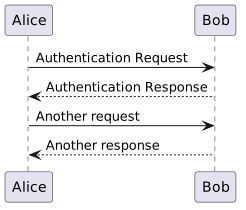
Wrap every diagram in @startuml ... @enduml, save as .puml and render — see Rendering:
| Source (.puml) | Rendered |
|---|---|
@startuml
Alice -> Bob: Authentication Request
Bob --> Alice: Authentication Response

Alice -> Bob: Another request
Alice <-- Bob: Another response
@enduml
|
 |
Sequence diagrams
The workhorse. A message is sender arrow receiver: text — the text after the colon is the label.
| Arrow | Renders as |
|---|---|
-> |
solid line, no arrowhead |
--> |
dashed line, no arrowhead (typical reply) |
->> |
solid line with arrowhead |
-->> |
dashed line with arrowhead |
-x |
line ending in a cross (destroys the lifeline) |
-) |
line ending in an open arrowhead |
Solid for synchronous calls, dashed for replies and asynchronous messages.
Participants — declare to control order and role. as NAME gives an alias: the quoted text is displayed, the alias is used in messages.
@startuml
participant "Web App" as WA
actor "Customer" as C
database "Postgres" as DB
entity E
control Ctrl
boundary B
queue Q
@enduml
Role keywords: actor, participant, database, entity, control, boundary, queue.
Activations, notes and fragments:
| Source (.puml) | Rendered |
|---|---|
@startuml
participant "Web App" as WA
database "Postgres" as DB

WA -> DB: SELECT * FROM orders
activate DB
DB --> WA: rows
deactivate DB

note right of DB: covered by index

alt rows found
  WA -> WA: render table
else empty
  WA -> WA: show placeholder
end

loop retry x3
  WA -> WA: backoff
end
@enduml
|
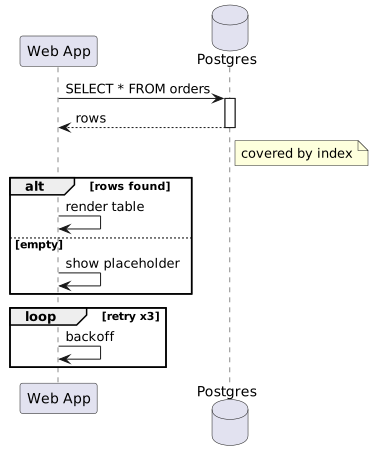 |
activate / deactivate — draw a lifeline bar. Shorthand:
DB ++...DB --;return valuesends a dashed reply and deactivates.Fragments —
alt/else,opt,loop,par/and,break,critical,group label— all close withend.Notes —
note left of X,note right of X,note over X,note over X, Y.Numbering —
autonumberlabels messages 1, 2, 3...
Class diagrams
| Source (.puml) | Rendered |
|---|---|
@startuml
class Animal {
  +name: string
  -age: int
  +speak(): void
}

Animal <|-- Dog
Dog *-- Collar
@enduml
|
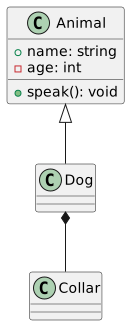 |
Visibility markers: + public, - private, # protected, ~ package. Kinds: abstract class, interface, enum.
Relations — labels and multiplicities go at the ends:
| Symbol | Meaning |
|---|---|
Animal <|-- Dog |
inheritance (also class Dog extends Animal)
|
..|> |
realization (implements an interface) |
*-- |
composition |
o-- |
aggregation |
-- / --> |
association |
..> |
dependency |
Dog "1" *-- "0..*" Collar : has
Use case diagrams
| Source (.puml) | Rendered |
|---|---|
@startuml
left to right direction
actor Customer
rectangle "Web shop" {
  (Login)
  (Browse catalog)
}
Customer --> (Login)
(Login) ..> (Browse catalog) : include
@enduml
|
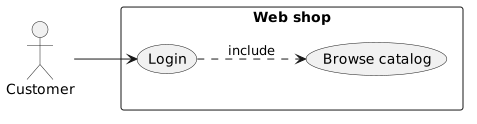 |
Use cases in parentheses (Login) or usecase "Login" as L; boundaries with rectangle "name" { ... } or package. Dotted arrows express include / extend.
Activity diagrams
| Source (.puml) | Rendered |
|---|---|
@startuml
start
:Fetch order;
if (in stock?) then (yes)
  :Ship order;
else (no)
  :Notify customer;
endif
stop
@enduml
|
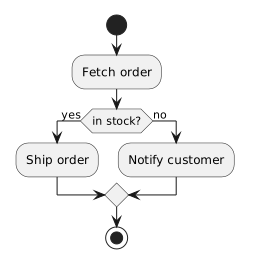 |
:action; is a step; if (cond) then (yes) ... else (no) ... endif a decision. Also while (cond) ... endwhile and fork ... end fork for concurrency.
State diagrams
| Source (.puml) | Rendered |
|---|---|
@startuml
[*] --> Idle
Idle --> Running : start()
Running --> Idle : stop()
Running --> [*] : terminate
@enduml
|
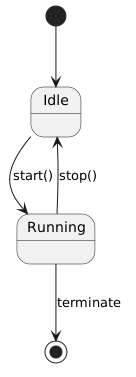 |
[*] is the initial/final state; State --> State : event labels a transition. Long names: state "Waiting for input" as Waiting.
Component & deployment
| Source (.puml) | Rendered |
|---|---|
@startuml
node "Server" {
  [Web] --> [App]
}
node "Database" {
  database "Postgres" as pg
}
[App] --> pg
@enduml
|
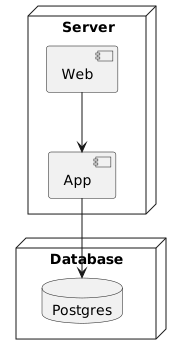 |
Square brackets for components, database "name" for datastores, node "name" { ... } / package { ... } for containers.
Common syntax
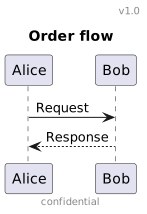
Comments and document-level decorations — title, header, footer, legend:
' single-line comment
/' multi-line
   comment '/

title Order flow
' diagram title
header v1.0
' repeated header
footer page %page% of %lastpage%
' %page%/%lastpage%: page numbers
Start Comments
'at the beginning of a new line. Avoid trailing comments:title Order flow ' diagram titlecan cause a parse error as plantUML considers non-leading'orphaned.In a header/footer,
%page%/%lastpage%become page numbers once the diagram spans several pages.
| Source (.puml) | Rendered |
|---|---|
@startuml
title Order flow
header v1.0
footer confidential

Alice -> Bob: Request
Bob --> Alice: Response
@enduml
|
 |
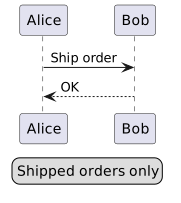
@startuml
legend right
Shipped orders only
endlegend

Alice -> Bob: Ship order
Bob --> Alice: OK
@enduml
|
 |
Creole
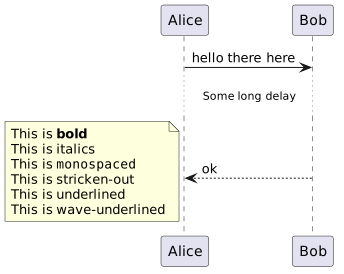
Creole is a lightweight markup for styling text anywhere in a diagram — labels, notes, titles, class members. All diagram types support it.
| Source (.puml) | Rendered |
|---|---|
@startuml
Alice -> Bob: hello --there-- here
... Some ~~long delay~~ ...
Bob --> Alice: ok
note left
  This is **bold**
  This is //italics//
  This is ""monospaced""
  This is --stricken-out--
  This is __underlined__
  This is ~~wave-underlined~~
end note
@enduml
|
 |
| Creole | Renders as | HTML equivalent |
|---|---|---|
**bold** |
bold | <b>…</b>
|
//italics// |
italic | <i>…</i>
|
""monospaced"" |
monospaced | <font:monospaced>…</font>
|
--stricken-out-- |
strikethrough | <s>…</s>
|
__underlined__ |
underlined | <u>…</u>
|
~~wave-underlined~~ |
wavy underline | <w>…</w>
|
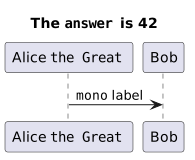
In double-quoted strings —
""monospaced""works in quoted content — titles, notes, message labels — but not in quoted element names likeparticipant "Alice ..."orstate "Waiting ..." as W: the""collides with the string delimiter and the diagram fails to parse. Use the HTML form there instead:
Source (.puml) Rendered
| Source (.puml) | Rendered |
|---|---|
@startuml
object demo {
  * Bullet list
  * Second item
  ** Sub item
}
note as n
  * Bullet list
  * Second item
  ** Sub item
  ----
  # Numbered list
  # Second item
  ## Sub item
end note
@enduml
|
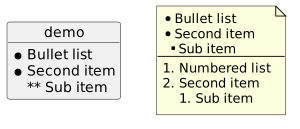 |
Lists — * bullet, # numbered; repeat the marker to nest (**, ##). You cannot mix bullets and numbers in one list.
Horizontal lines — ---- single, ==== double, ____ strong, ..My title.. dotted with title, ==Title== / --Another title-- with a title.
| Source (.puml) | Rendered |
|---|---|
@startuml
title "The ""answer"" is <U+221E>"
Alice -> Bob: <:1f600:> [[http://plantuml.com docs]]
Alice -> Bob: Recolor: <#green:sunny:>
note right
  = Heading
  == Sub heading
  <code>
  main() {
    printf("Hello world");
  }
  </code>
end note
@enduml |
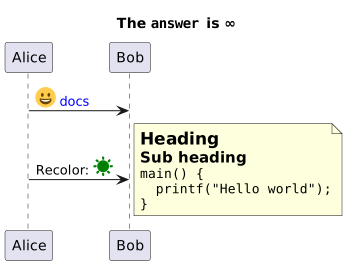 |
Links — [[http://plantuml.com]], [[http://plantuml.com This label is printed]], with tooltip [[http://plantuml.com{Optional tooltip} This label is printed]] — three brackets link to a field or method on class diagrams.
Emoji & icons — Twemoji emoji are always available (no font dependency) and already colored: <:1f600:>, recolored <#green:sunny:>. OpenIconic icons: <&heart>. List them with the special commands emoji and listopeniconic.
Headings & special chars — inside quoted multi-line labels: = Head, == Sub, === Sub-sub. Any Unicode char works directly, or as <U+221E> (hex) / ∞ (decimal).
Code — <code>…</code> shows source code without syntax highlighting.
Legacy HTML — colors, sizes, images, sub/superscripts: <color:red>…</color>, <back:cadetblue>…</back>, <size:18>…</size>, <img:https://…>, <sub> / <sup>.
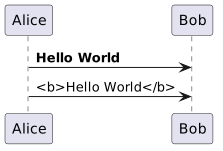
| Source (.puml) | Rendered |
|---|---|
@startuml
Alice -> Bob: <b>Hello World</b>
Alice -> Bob: ~<b>Hello World~</b>
@enduml |
 |
@startuml
Alice -> Bob: [[Wiki Home]]
Alice -> Bob: ~[[Wiki Home]]
@enduml |
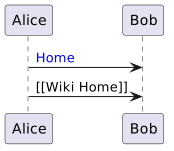 |
Escaping — ~ prints the next special character literally; unescaped, PlantUML interprets it as creole markup:
Full reference: PlantUML Creole.
Notes
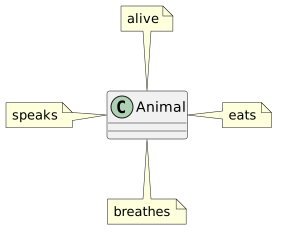
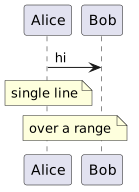
A note is a box of text attached to an element of any diagram type — participant, class, state, use case, link. Sequence-diagram notes are covered in Sequence diagrams; here is the general shape:
| Source (.puml) | Rendered |
|---|---|
@startuml
class Animal

note left of Animal : speaks
note right of Animal : eats
note top of Animal : alive
note bottom of Animal : breathes
@enduml |
 |
@startuml
participant Alice
participant Bob
Alice -> Bob: hi

note over Alice : single line
note over Alice, Bob : over a range
@enduml |
 |
@startuml
start
:Fetch order;
note : floating single-line note
:Ship order;
stop
@enduml |
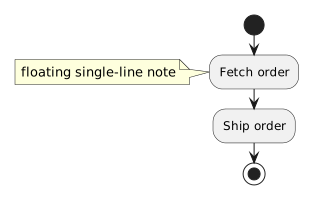 |
Placement —
left of X,right of X,top of X,bottom of X, works in the single-line format with the text after a colon, but may not work with other note syntaxes in some scenarios.
In sequence diagrams
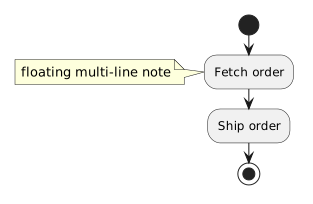
over X/over X, Yspan one or a range of participants; in activity diagramsnotealone (ornote right) floats beside the current step.
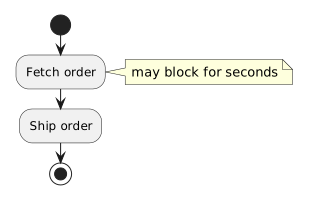
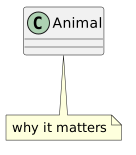
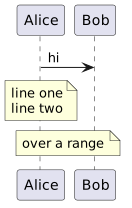
Long text, or several lines: open a note block and close with end note. A note with a quoted title becomes free-floating — attach it to an element with a dotted line:
| Source (.puml) | Rendered |
|---|---|
@startuml
start
:Fetch order;
note right
  may block for seconds
end note
:Ship order;
stop
@enduml |
 |
@startuml
class Animal

note "why it matters" as N1
Animal .. N1
@enduml |
 |
@startuml
participant Alice
participant Bob
Alice -> Bob: hi

note over Alice
  line one
  line two
end note
note over Alice, Bob
  over a range
end note
@enduml |
 |
@startuml
start
:Fetch order;
note
  floating multi-line note
end note
:Ship order;
stop
@enduml |
 |
Theme
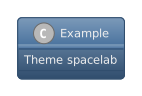
Swap the whole look with one directive at the top of the diagram — themes ship with PlantUML, nothing to install:
| Source (.puml) | Rendered |
|---|---|
@startuml
!theme spacelab
class Example {
  Theme spacelab
}
@enduml |
 |
help themesrenders the full list of built-in themes.- Your own theme:
!theme foo from /path/to/folder— a file namedpuml-theme-foo.puml(remote URLs work too). - Some themes add message helpers:
$success("…"),$failure("…"),$warning("…").
Browse the gallery of official themes. Full reference: PlantUML Themes.
Style
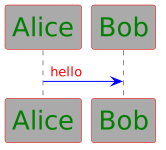
CSS-like <style> blocks replace the deprecated skinparam. Selectors target everything (element), one diagram type (sequenceDiagram, classDiagram, …) or one element (participant, arrow, node, …):
| Source (.puml) | Rendered |
|---|---|
@startuml
<style>
element {
  BackGroundColor: #AAA;
}
sequenceDiagram {
  participant {
    FontColor: green;
    FontSize: 26;
    FontStyle: italic;
    LineColor: #E00;
  }
  arrow {
    FontColor: red;
    LineColor: blue;
  }
}
</style>

participant Alice
participant Bob
Alice -> Bob : hello
@enduml |
 |
Common properties: FontColor, FontSize, FontStyle, FontName; BackGroundColor, LineColor, LineThickness, RoundCorner, Padding, Shadowing. Custom classes: tag an element as X <<primary>>, then style .primary { ... }.
Full reference: PlantUML Styles.
Rendering
| Tool | How |
|---|---|
| This wiki | <uml> ... </uml> — see rendering diagrams on this wiki
|
| CLI | java -jar plantuml.jar diagram.puml → diagram.png (Java required; GraphViz only for some diagram types)
|
| VS Code | PlantUML extension — Alt+D previews the diagram live
|
| Browser | plantuml.com online server; Kroki |
| GitLab | ```plantuml fenced blocks render natively (when enabled on the instance)
|
CLI options:
plantuml diagram.puml            # PNG (default)
plantuml -tsvg diagram.puml      # SVG
plantuml -tutxt diagram.puml     # ASCII art
plantuml -o out/ diagram.puml    # output directory
plantuml *.puml # whole directory- PlantUML — official site; every diagram type has its own page (sequence-diagram, class-diagram, use-case-diagram, …)
- Quick Start Guide — install, first diagram
- PlantUML Language Reference Guide — the full syntax
- PlantUML Creole — styled text in any diagram
- PlantUML Themes — built-in themes, one-line look change
- PlantUML Styles — CSS-like styling, the skinparam replacement
- Kroki — render PlantUML inside Markdown, AsciiDoc, reStructuredText, …
- PlantUML VS Code extension