HowItWorks:Git: Difference between revisions
Creating HowItWorks:Git — AI-assisted (RonzzWikiCowriter) (via create-page on MediaWiki MCP Server) |
|||
| (19 intermediate revisions by 2 users not shown) | |||
| Line 1: | Line 1: | ||
{{HowItWorks}} | {{HowItWorks}} | ||
'''Git''' is a free and open source distributed version control system, designed to handle | '''Git''' is a free and open source distributed version control system, designed to handle projects of any size with speed and efficiency.<ref>{{#cite:Q1455}}</ref> Written in C and released under the GNU General Public License v2, it was created by [[Person:Linus Torvalds|Linus Torvalds]] in April 2005 to manage the Linux kernel source code, and is today maintained by [[Person:Junio Hamano|Junio C. Hamano]].<ref>{{#cite:Q1465}}</ref><ref>{{#cite:Q1456}}</ref> | ||
== Git, a distributed version control system == | == Git, a distributed version control system == | ||
| Line 7: | Line 7: | ||
A '''version control system''' (VCS) records changes to a set of files over time, so that any past version can be recalled later. Without one, a project is just a folder of files that only moves forward: a wrong edit cannot be undone, and two people editing the same files quickly overwrite each other. | A '''version control system''' (VCS) records changes to a set of files over time, so that any past version can be recalled later. Without one, a project is just a folder of files that only moves forward: a wrong edit cannot be undone, and two people editing the same files quickly overwrite each other. | ||
Most older systems | Most older systems, such as CVS, Subversion, and Perforce, are '''centralized''': one server holds the canonical repository, and anything that needs history must travel over the network to that server. In contrast, Git is '''distributed''': every clone of a repository is a complete repository with the entire history, so nearly every operation can be done locally, without a network connection.<ref>{{#cite:Q1457}}</ref> | ||
Git | Git functions by storing multiple versions of each tracked file, classified into three states: | ||
* | * '''Committed''': immutable, permanent snapshots in the project's history, made when user calls <code>git commit</code>. Git stores those snapshots in its object database in the '''Git directory''' (normally <code>.git/</code>), alongside the project metadata. When you clone a repository, this is what gets copied.<ref>{{#cite:Q1457}}</ref> User can recall any snapshot later with <code>git checkout</code> or <code>git switch</code>. | ||
* | * '''Modified''': This is the on-disk version of a file. Any changes since the last commit are stored in a '''working tree'''<ref>{{#cite:Q1457}}</ref> | ||
* | * '''Staged''': A temporary snapshot of a modified file made when user called <code>git add</code> on the file. Technically named the "index", it becomes a new immutable, permanent snapshot (commit) when user gives Git the go-ahead by calling the <code>git commit</code> command.<ref>{{#cite:Q1457}}</ref> | ||
Those different versions of the same file becomes the base of the '''Git history''', a permanent record of changes made to files in a project. Via various commands, users can search it, revert the project to a particular state, or even cherry-pick certain changes on top of each other in a desired order on top of a base state to make a new state. Furthermore, users can even create parallel sub-tracks in the Git history via branches to allow the project to simultaneously evolve in different directions, temporarily or permanently, facilitating multi-user collaboration.<ref>{{#cite:Q1457}}</ref> | |||
As of 2026, Git is effectively THE standard for version control in software development.<ref>{{#cite:Q1456}}</ref> | |||
== A short history == | == A short history == | ||
Git was born out of the needs of the Linux kernel project | Git was born out of the needs of the Linux kernel project.<ref>{{#cite:Q1458}}</ref> | ||
In | In the early days of Linux, from 1991 to 2002, kernel changes were passed around as patches and archived files, which worked fine as the number of contributors is relatively low. | ||
Around 2002, as the number of developers increased, this spontaneous, haphazard system started to break down. It became increasingly cumbersome to keep everyone on the same page. A version control system, became therefore a necessity. BitKeeper, a proprietary distributed version control system, was offered free-of-charge to the Linux kernel project and was adopted.<ref>{{#cite:Q1458}}</ref> | |||
In | In 2005, the relationship between the kernel community and BitMover Inc., the company that owns BitKeeper, broke down. BitMover Inc., citing a violation of its license terms, revoked the Linux kernel project's free-of-charge access to BitKeeper. Rather than making concessions to negotiate a new term of access with BitMover Inc., the Linux development community — in particular [[Person:Linus Torvalds|Linus Torvalds]], the creator of Linux, decided to build their own better, more efficient version-control tool based on the lessons learned from BitKeeper. The stated goals of the new system was ambitious: speed; simple design; strong support for non-linear development (thousands of parallel branches); fully distributed; and able to handle large projects like the Linux kernel efficiently.<ref>{{#cite:Q1458}}</ref> | ||
On April 7, 2005, after about 10 days of devoted development, Torvalds made the first commit to the new system — commit <code>e83c5163</code> — with the self-deprecating message "Initial revision of 'git', the information manager from hell".<ref>{{#cite:Q1465}}</ref> The name 'git' itself is a joke: it is a British slang for an unpleasant person. According to the README included in that very first commit, "it can mean anything, depending on your mood": "global information tracker" when you are in a good mood, and "goddamn idiotic truckload of sh*t" when it breaks.<ref>{{#cite:Q1465}}</ref> | |||
Later in 2005, to reconcentrate himself on Linux kernel development, Torvalds handed the project over to [[Person:Junio Hamano|Junio C. Hamano]], who has maintained it ever since.<ref>{{#cite:Q1456}}</ref> | |||
In | In May 2014, Git 2.0, which carried large backward-incompatible changes, was released<ref>{{#cite:Q1464}}</ref> | ||
In 2020, Git 2.29 introduced experimental support for the SHA-256 object format alongside the long-standing SHA-1.<ref>{{#cite:Q1460}}</ref> | |||
As of September 2026, the project is preparing for Git 3.0, a breaking release that plans to make SHA-256 the default hash function for new repositories, switch the default reference storage to the reftable format, adopt "main" as the default branch name, and make Rust a mandatory part of the build.<ref>{{#cite:Q1464}}</ref> | |||
== Components and interactions == | == Components and interactions == | ||
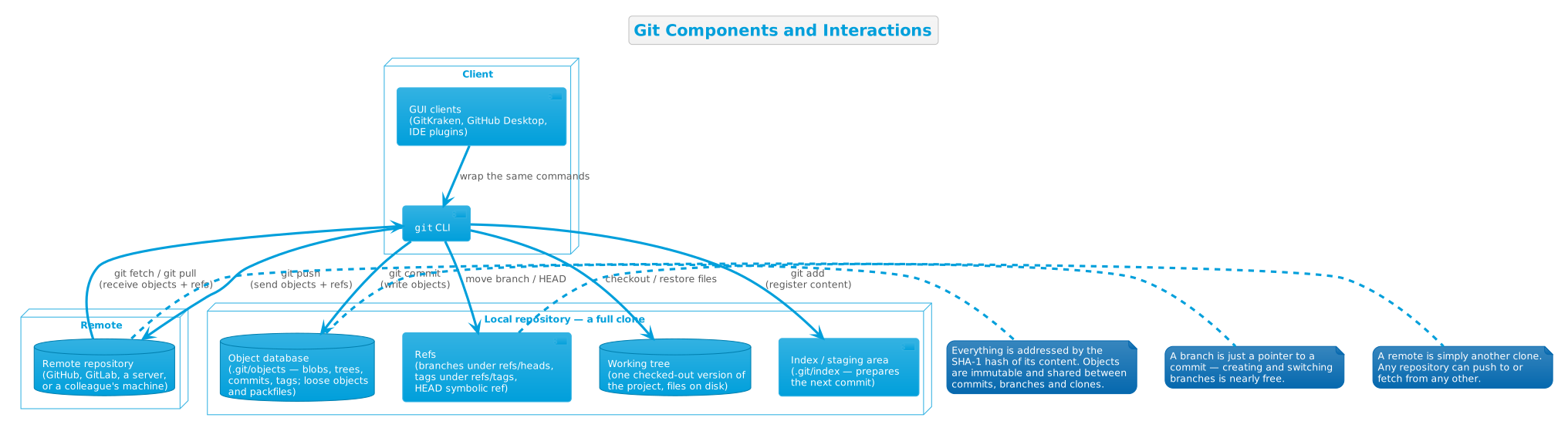
A Git repository | A Git repository consists usually of a working directory with a <code>.git</code> subdirectory at the top level. | ||
The <code>.git</code> directory contains, among other things, a compressed object database representing the complete history of the project, an index file that links that history to the current contents of the working tree, and named pointers into that history — tags and branch heads.<ref>{{#cite:Q1456}}</ref> | |||
<uml> | <uml> | ||
| Line 87: | Line 93: | ||
@enduml | @enduml | ||
</uml> | </uml> | ||
== Git in action == | == Git in action == | ||
| Line 130: | Line 127: | ||
</uml> | </uml> | ||
<ref>{{#cite:Q1463}}</ref> | |||
=== Syncing with a remote === | === Syncing with a remote === | ||
| Line 171: | Line 160: | ||
@enduml | @enduml | ||
</uml> | </uml> | ||
== Key design decisions == | == Key design decisions == | ||
| Line 180: | Line 165: | ||
=== Snapshots, not differences === | === Snapshots, not differences === | ||
The | The radical difference between Git and earlier version control systems is that instead of storing commits as deltas (changes made in comparison to previous version), Git stores commits as snapshots: exact state of changed files at commit time.<ref>{{#cite:Q1457}}</ref> | ||
This snapshot approach is robust: unlike in delta-based version control systems, corruption of a commit state would not propagate to all newer commits based on that commit. | |||
What's more, this approach also renders large rollbacks trivial: rolling back to the state of any commit, even those from 5 years ago, consists of a simple object database query to pull up a particular snapshot, and not mathematically computing the desired state by reverting all new deltas from the latest state. | |||
=== Nearly every operation is local === | === Nearly every operation is local === | ||
Another important difference between Git and earlier version-control systems is that most operations can be completed locally. | |||
While most earlier systems rely on the central, authoritative "bookkeeping" server for almost every operation, Git is distributed. Each repository clone contains the entire Git history, which means most git operations, like browsing and diffing old versions, committing and branching all work instantly and offline. Syncing with a server is entirely optional. <ref>{{#cite:Q1457}}</ref> | |||
This distributed design made Git extremely suitable for large Opensource projects with thousands of contributors. The load on the central "bookkeeping" server is minimal: contributors call <code>git clone</code> to copy the repository to their local machine once, then everything happens locally on their machine, until they have arrived at something meaningful to be shared back with the entire community, at which point they call <code>git push</code> to sync back their changes to the central server. | |||
=== Storage by hash value, not file name === | |||
Git stores everything in its database by the hash value of its contents, not file name.<ref>{{#cite:Q1457}}</ref><ref>{{#cite:Q1463}}</ref> | |||
This design offers multiple benefits: | |||
* '''Guaranteed integrity''': Any corruption to a file's content becomes immediately obvious to Git at retrieval time: the hash value simply would not match. | |||
* '''Safe indefinite caching''': A cached version of any file never becomes silently stale. Git can instantly verify its freshness by comparing the hash value to the latest version. | |||
* '''Zero-cost file renaming''': When user renames a file (e.g., from README to README.md), the hash value, which is calculated uniquely based on a file's content, stays constant. Therefore, no change is needed in Git's object storage when a file is renamed. | |||
=== Branches are cheap pointers === | === Branches are cheap pointers === | ||
A branch is not a copy of the tree | A branch is not a copy of the Git tree nor a container of commits — it is just a thin <code>ref</code>, a 41-byte pointer to a commit. Therefore, creating and merging branches cost next-to-nothing, delivering the original design goal of "strong support for non-linear development (thousands of parallel branches)".<ref>{{#cite:Q1456}}</ref><ref>{{#cite:Q1458}}</ref><ref>{{#cite:Q1456}}</ref> | ||
=== A three-part staging model === | === A three-part staging model === | ||
By interposes the '''index (staging area)''' between the working tree and the repository, Git ensures that nothing is committed unless user explicitly requests it with <code>git add</code>. In addition to providing surgical precision for each commit, this design also discourages contributors from making odd-time commits just to "save work".<ref>{{#cite:Q1457}}</ref> | |||
=== Plumbing and porcelain === | === Plumbing and porcelain === | ||
Git is | For small-scale projects with only a few contributors, manually managing Git history is quite doable. However, for large projects with thousands of contributors, manual Git history management can quickly become a full-time job, making scripting/advanced Git management tools highly desirable. | ||
To satisfy both needs, Git exposes two sets of commands: a "'''porcelain'''" set of high-level commands designed to be directly called by human users, and a "'''plumbing'''" set of low-level commands exposing direct object storage, index, and ref manipulation, designed primarily for scripted use. The "plumbing" commands are deliberately stable across versions to ensure lasting compatibility of user scripts and tools.<ref>{{#cite:Q1456}}</ref> | |||
=== Git stores everything === | |||
Git is built within the 21st century context: storage is cheap; data loss is costly. | |||
Once a Git commit is made, the commit-time project snapshot stays in the project's Git object storage forever. Even commands that rewrites Git history, such as <code>amend</code>, <code>rebase</code>, and <code>reset</code> do not erase them.<ref>{{#cite:Q1457}}</ref> | |||
" | Although the "store everything" approach inevitably introduces an storage overhead, the storage overhead's size is much smaller than the mathematical product of the number of commits and the repo's size, thanks to Git's backend performing aggressive compression and optimisation on its object storage. The data-integrity benefits outweigh the additional storage cost by far on any reasonably modern computer system. | ||
=== Backward compatibility | === Backward compatibility is broken only when strictly necessary === | ||
" | According to Git's official website: "the Git project aims to ensure backwards compatibility to the best extent possible. Minor releases will not break backwards compatibility unless there is a very strong reason to do so." But the project "irregularly releases breaking versions that deliberately break backwards compatibility", to stay "relevant, safe and maintainable going forward". | ||
Two decades onward since Git's birth, there have only been two breaking changes : once in 2008 with Git 1.6.0, and once in 2014 with Git 2.0. The next one, Git 3.0, is planned for end of 2026.<ref>{{#cite:Q1464}}</ref> | |||
== Try it yourself == | == Try it yourself == | ||
Commands reproduced from Git's official documentation.<ref>{{#cite:Q1459}}</ref> | |||
< | <blockquote> | ||
Syntax of certain commands may be different on Windows. | |||
</blockquote> | |||
<syntaxhighlight lang="bash" copy> | |||
# 1. Which version do you have? | # 1. Which version do you have? | ||
git --version | git --version | ||
</ | </syntaxhighlight> | ||
Output (your version depends on your install): | |||
<pre> | <pre> | ||
| Line 227: | Line 236: | ||
</pre> | </pre> | ||
< | <syntaxhighlight lang="bash" copy> | ||
# 2. The very first commit of git.git, via the GitHub API | # 2. The very first commit of git.git, via the GitHub API | ||
curl -s "https://api.github.com/repos/git/git/commits/e83c5163316f89bfbde7d9ab23ca2e25604af290" \ | curl -s "https://api.github.com/repos/git/git/commits/e83c5163316f89bfbde7d9ab23ca2e25604af290" \ | ||
| grep -E '"name"|"date"|"message"' | | grep -E '"name"|"date"|"message"' | ||
</ | </syntaxhighlight> | ||
Output ( | Output (liveness check performed 2026-09-01): | ||
<pre> | <pre> | ||
| Line 243: | Line 252: | ||
</pre> | </pre> | ||
< | <syntaxhighlight lang="bash" copy> | ||
# 3. The latest feature release and its date, from the official website | # 3. The latest feature release and its date, from the official website | ||
curl -s https://git-scm.com/ | grep -oE "2\.55\.0|2026-06-29" | sort -u | curl -s https://git-scm.com/ | grep -oE "2\.55\.0|2026-06-29" | sort -u | ||
</ | </syntaxhighlight> | ||
Output ( | Output (liveness check performed 2026-09-01): | ||
<pre> | <pre> | ||
| Line 255: | Line 264: | ||
</pre> | </pre> | ||
< | <syntaxhighlight lang="bash" copy> | ||
# 4. Git is a content-addressable store: hash some content, get back its key | # 4. Git is a content-addressable store: hash some content, get back its key | ||
echo 'test content' | git hash-object -w --stdin | echo 'test content' | git hash-object -w --stdin | ||
</ | </syntaxhighlight> | ||
Output: | |||
<pre> | <pre> | ||
| Line 266: | Line 275: | ||
</pre> | </pre> | ||
< | <syntaxhighlight lang="bash" copy> | ||
# 5. Read the object back by its key | # 5. Read the object back by its key | ||
git cat-file -p d670460b4b4aece5915caf5c68d12f560a9fe3e4 | git cat-file -p d670460b4b4aece5915caf5c68d12f560a9fe3e4 | ||
</ | </syntaxhighlight> | ||
Output: | |||
<pre> | <pre> | ||
| Line 277: | Line 286: | ||
</pre> | </pre> | ||
< | <syntaxhighlight lang="bash" copy> | ||
# 6. Where did it go? Objects are stored under .git/objects, sharded by hash | # 6. Where did it go? Objects are stored under .git/objects, sharded by hash | ||
find .git/objects -type f | find .git/objects -type f | ||
</ | </syntaxhighlight> | ||
Output: | |||
<pre> | <pre> | ||
| Line 288: | Line 297: | ||
</pre> | </pre> | ||
< | <syntaxhighlight lang="bash" copy> | ||
# 7. A real project: init, add, commit, log | # 7. A real project: init, add, commit, log | ||
mkdir demo && cd demo | mkdir demo && cd demo | ||
git init | git init | ||
</ | </syntaxhighlight> | ||
Output (path depends on where you run it): | |||
<pre> | <pre> | ||
| Line 300: | Line 309: | ||
</pre> | </pre> | ||
< | <syntaxhighlight lang="bash" copy> | ||
echo "Hello, Git!" > README.md | echo "Hello, Git!" > README.md | ||
git add README.md | git add README.md | ||
git commit -m "first commit" | git commit -m "first commit" | ||
</ | </syntaxhighlight> | ||
Output (hashes and authorship vary): | |||
<pre> | <pre> | ||
| Line 314: | Line 323: | ||
</pre> | </pre> | ||
< | <syntaxhighlight lang="bash" copy> | ||
git log --oneline | git log --oneline | ||
</ | </syntaxhighlight> | ||
Output: | |||
<pre> | <pre> | ||
| Line 324: | Line 333: | ||
</pre> | </pre> | ||
< | <syntaxhighlight lang="bash" copy> | ||
# 8. A commit object is just text: tree, author, committer, message | # 8. A commit object is just text: tree, author, committer, message | ||
git cat-file -p HEAD | git cat-file -p HEAD | ||
</ | </syntaxhighlight> | ||
Output (hashes, identity and timestamps vary):<ref>{{#cite:Q1463}}</ref> | |||
<pre> | <pre> | ||
| Line 338: | Line 347: | ||
First commit | First commit | ||
</pre> | </pre> | ||
== References == | == References == | ||
Latest revision as of 14:25, 1 September 2026
Explains how things actually work — part of our technology dissections collection.
Git is a free and open source distributed version control system, designed to handle projects of any size with speed and efficiency.[1] Written in C and released under the GNU General Public License v2, it was created by Linus Torvalds in April 2005 to manage the Linux kernel source code, and is today maintained by Junio C. Hamano.[2][3]
Git, a distributed version control system
A version control system (VCS) records changes to a set of files over time, so that any past version can be recalled later. Without one, a project is just a folder of files that only moves forward: a wrong edit cannot be undone, and two people editing the same files quickly overwrite each other.
Most older systems, such as CVS, Subversion, and Perforce, are centralized: one server holds the canonical repository, and anything that needs history must travel over the network to that server. In contrast, Git is distributed: every clone of a repository is a complete repository with the entire history, so nearly every operation can be done locally, without a network connection.[4]
Git functions by storing multiple versions of each tracked file, classified into three states:
- Committed: immutable, permanent snapshots in the project's history, made when user calls
git commit. Git stores those snapshots in its object database in the Git directory (normally.git/), alongside the project metadata. When you clone a repository, this is what gets copied.[4] User can recall any snapshot later withgit checkoutorgit switch. - Modified: This is the on-disk version of a file. Any changes since the last commit are stored in a working tree[4]
- Staged: A temporary snapshot of a modified file made when user called
git addon the file. Technically named the "index", it becomes a new immutable, permanent snapshot (commit) when user gives Git the go-ahead by calling thegit commitcommand.[4]
Those different versions of the same file becomes the base of the Git history, a permanent record of changes made to files in a project. Via various commands, users can search it, revert the project to a particular state, or even cherry-pick certain changes on top of each other in a desired order on top of a base state to make a new state. Furthermore, users can even create parallel sub-tracks in the Git history via branches to allow the project to simultaneously evolve in different directions, temporarily or permanently, facilitating multi-user collaboration.[4]
As of 2026, Git is effectively THE standard for version control in software development.[3]
A short history
Git was born out of the needs of the Linux kernel project.[5]
In the early days of Linux, from 1991 to 2002, kernel changes were passed around as patches and archived files, which worked fine as the number of contributors is relatively low.
Around 2002, as the number of developers increased, this spontaneous, haphazard system started to break down. It became increasingly cumbersome to keep everyone on the same page. A version control system, became therefore a necessity. BitKeeper, a proprietary distributed version control system, was offered free-of-charge to the Linux kernel project and was adopted.[5]
In 2005, the relationship between the kernel community and BitMover Inc., the company that owns BitKeeper, broke down. BitMover Inc., citing a violation of its license terms, revoked the Linux kernel project's free-of-charge access to BitKeeper. Rather than making concessions to negotiate a new term of access with BitMover Inc., the Linux development community — in particular Linus Torvalds, the creator of Linux, decided to build their own better, more efficient version-control tool based on the lessons learned from BitKeeper. The stated goals of the new system was ambitious: speed; simple design; strong support for non-linear development (thousands of parallel branches); fully distributed; and able to handle large projects like the Linux kernel efficiently.[5]
On April 7, 2005, after about 10 days of devoted development, Torvalds made the first commit to the new system — commit e83c5163 — with the self-deprecating message "Initial revision of 'git', the information manager from hell".[2] The name 'git' itself is a joke: it is a British slang for an unpleasant person. According to the README included in that very first commit, "it can mean anything, depending on your mood": "global information tracker" when you are in a good mood, and "goddamn idiotic truckload of sh*t" when it breaks.[2]
Later in 2005, to reconcentrate himself on Linux kernel development, Torvalds handed the project over to Junio C. Hamano, who has maintained it ever since.[3]
In May 2014, Git 2.0, which carried large backward-incompatible changes, was released[6]
In 2020, Git 2.29 introduced experimental support for the SHA-256 object format alongside the long-standing SHA-1.[7]
As of September 2026, the project is preparing for Git 3.0, a breaking release that plans to make SHA-256 the default hash function for new repositories, switch the default reference storage to the reftable format, adopt "main" as the default branch name, and make Rust a mandatory part of the build.[6]
Components and interactions
A Git repository consists usually of a working directory with a .git subdirectory at the top level.
The .git directory contains, among other things, a compressed object database representing the complete history of the project, an index file that links that history to the current contents of the working tree, and named pointers into that history — tags and branch heads.[3]
Git in action
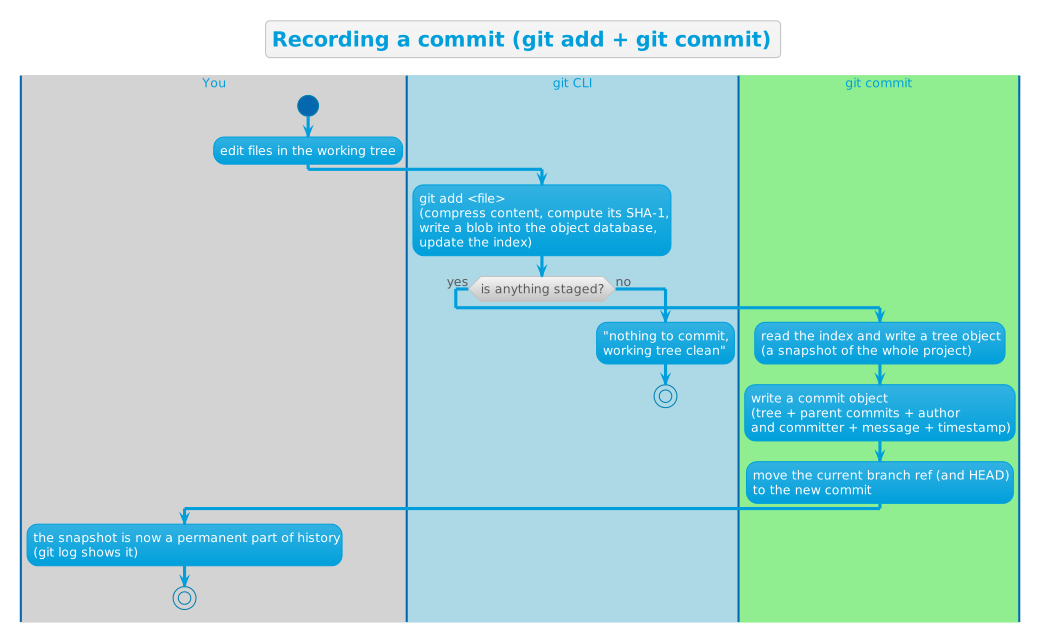
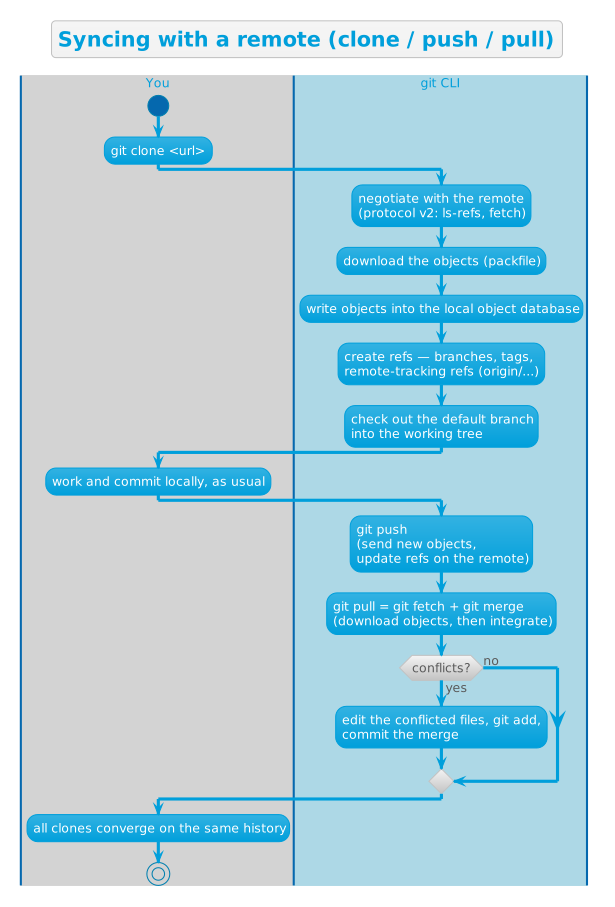
Two flows cover most of everyday Git: recording a commit (the snapshot machine) and syncing with a remote (the distributed part).
Recording a commit
Syncing with a remote
Key design decisions
Snapshots, not differences
The radical difference between Git and earlier version control systems is that instead of storing commits as deltas (changes made in comparison to previous version), Git stores commits as snapshots: exact state of changed files at commit time.[4]
This snapshot approach is robust: unlike in delta-based version control systems, corruption of a commit state would not propagate to all newer commits based on that commit.
What's more, this approach also renders large rollbacks trivial: rolling back to the state of any commit, even those from 5 years ago, consists of a simple object database query to pull up a particular snapshot, and not mathematically computing the desired state by reverting all new deltas from the latest state.
Nearly every operation is local
Another important difference between Git and earlier version-control systems is that most operations can be completed locally.
While most earlier systems rely on the central, authoritative "bookkeeping" server for almost every operation, Git is distributed. Each repository clone contains the entire Git history, which means most git operations, like browsing and diffing old versions, committing and branching all work instantly and offline. Syncing with a server is entirely optional. [4]
This distributed design made Git extremely suitable for large Opensource projects with thousands of contributors. The load on the central "bookkeeping" server is minimal: contributors call git clone to copy the repository to their local machine once, then everything happens locally on their machine, until they have arrived at something meaningful to be shared back with the entire community, at which point they call git push to sync back their changes to the central server.
Storage by hash value, not file name
Git stores everything in its database by the hash value of its contents, not file name.[4][8]
This design offers multiple benefits:
- Guaranteed integrity: Any corruption to a file's content becomes immediately obvious to Git at retrieval time: the hash value simply would not match.
- Safe indefinite caching: A cached version of any file never becomes silently stale. Git can instantly verify its freshness by comparing the hash value to the latest version.
- Zero-cost file renaming: When user renames a file (e.g., from README to README.md), the hash value, which is calculated uniquely based on a file's content, stays constant. Therefore, no change is needed in Git's object storage when a file is renamed.
Branches are cheap pointers
A branch is not a copy of the Git tree nor a container of commits — it is just a thin ref, a 41-byte pointer to a commit. Therefore, creating and merging branches cost next-to-nothing, delivering the original design goal of "strong support for non-linear development (thousands of parallel branches)".[3][5][3]
A three-part staging model
By interposes the index (staging area) between the working tree and the repository, Git ensures that nothing is committed unless user explicitly requests it with git add. In addition to providing surgical precision for each commit, this design also discourages contributors from making odd-time commits just to "save work".[4]
Plumbing and porcelain
For small-scale projects with only a few contributors, manually managing Git history is quite doable. However, for large projects with thousands of contributors, manual Git history management can quickly become a full-time job, making scripting/advanced Git management tools highly desirable.
To satisfy both needs, Git exposes two sets of commands: a "porcelain" set of high-level commands designed to be directly called by human users, and a "plumbing" set of low-level commands exposing direct object storage, index, and ref manipulation, designed primarily for scripted use. The "plumbing" commands are deliberately stable across versions to ensure lasting compatibility of user scripts and tools.[3]
Git stores everything
Git is built within the 21st century context: storage is cheap; data loss is costly.
Once a Git commit is made, the commit-time project snapshot stays in the project's Git object storage forever. Even commands that rewrites Git history, such as amend, rebase, and reset do not erase them.[4]
Although the "store everything" approach inevitably introduces an storage overhead, the storage overhead's size is much smaller than the mathematical product of the number of commits and the repo's size, thanks to Git's backend performing aggressive compression and optimisation on its object storage. The data-integrity benefits outweigh the additional storage cost by far on any reasonably modern computer system.
Backward compatibility is broken only when strictly necessary
According to Git's official website: "the Git project aims to ensure backwards compatibility to the best extent possible. Minor releases will not break backwards compatibility unless there is a very strong reason to do so." But the project "irregularly releases breaking versions that deliberately break backwards compatibility", to stay "relevant, safe and maintainable going forward".
Two decades onward since Git's birth, there have only been two breaking changes : once in 2008 with Git 1.6.0, and once in 2014 with Git 2.0. The next one, Git 3.0, is planned for end of 2026.[6]
Try it yourself
Commands reproduced from Git's official documentation.[9]
Syntax of certain commands may be different on Windows.
# 1. Which version do you have?
git --version
Output (your version depends on your install):
git version 2.55.0
# 2. The very first commit of git.git, via the GitHub API
curl -s "https://api.github.com/repos/git/git/commits/e83c5163316f89bfbde7d9ab23ca2e25604af290" \
  | grep -E '"name"|"date"|"message"'
Output (liveness check performed 2026-09-01):
"name":"Linus Torvalds",
"date":"2005-04-07T22:13:13Z",
"name":"Linus Torvalds",
"date":"2005-04-07T22:13:13Z",
"message":"Initial revision of \"git\", the information manager from hell",
# 3. The latest feature release and its date, from the official website
curl -s https://git-scm.com/ | grep -oE "2\.55\.0|2026-06-29" | sort -u
Output (liveness check performed 2026-09-01):
2026-06-29
2.55.0
# 4. Git is a content-addressable store: hash some content, get back its key
echo 'test content' | git hash-object -w --stdin
Output:
d670460b4b4aece5915caf5c68d12f560a9fe3e4
# 5. Read the object back by its key
git cat-file -p d670460b4b4aece5915caf5c68d12f560a9fe3e4
Output:
test content
# 6. Where did it go? Objects are stored under .git/objects, sharded by hash
find .git/objects -type f
Output:
.git/objects/d6/70460b4b4aece5915caf5c68d12f560a9fe3e4
# 7. A real project: init, add, commit, log
mkdir demo && cd demo
git init
Output (path depends on where you run it):
Initialized empty Git repository in /tmp/demo/.git/
echo "Hello, Git!" > README.md
git add README.md
git commit -m "first commit"
Output (hashes and authorship vary):
[master (root-commit) 6f1d2a3] first commit
 1 file changed, 1 insertion(+)
 create mode 100644 README.md
git log --oneline
Output:
6f1d2a3 (HEAD -> master) first commit
# 8. A commit object is just text: tree, author, committer, message
git cat-file -p HEAD
Output (hashes, identity and timestamps vary):[8]
tree d8329fc1cc938780ffdd9f94e0d364e0ea74f579
author Scott Chacon <schacon@gmail.com> 1243040974 -0700
committer Scott Chacon <schacon@gmail.com> 1243040974 -0700

First commit
References
- ↑ Torvalds, L. (n.d.). Git (Website).
- ↑ ↑ ↑ Torvalds, L. (2005). Initial revision of "git", the information manager from hell (Webpage). In GitHub · Change is constant. GitHub keeps you ahead. (Website).
- ↑ ↑ ↑ ↑ ↑ ↑ ↑ Torvalds, L. (n.d.). git - the stupid content tracker (Webpage). In Git (Website).
- ↑ ↑ ↑ ↑ ↑ ↑ ↑ ↑ ↑ ↑ Chacon, S. (2014). What is Git? (Webpage). In Git (Website).
- ↑ ↑ ↑ ↑ Chacon, S. (2014). A Short History of Git (Webpage). In Git (Website).
- ↑ ↑ ↑ Hamano, J. (n.d.). Git BreakingChanges Documentation (Webpage). In Git (Website).
- ↑ Hamano, J. (2020). Git 2.29 Release Notes (Webpage). In GitHub · Change is constant. GitHub keeps you ahead. (Website).
- ↑ ↑ ↑ Chacon, S. (2014). Git Objects (Webpage). In Git (Website).
- ↑ Chacon, S. (2014). Pro Git (Book). In Pro Git (Book) (p. 456). Apress.
Further reading
- Pro Git — the free book by Scott Chacon and Ben Straub, readable online
- Git Reference — official documentation, including the git manual and command pages
- Git documentation hub — book, videos, cheat sheet and references
- git/git — the source code repository
- Git BreakingChanges Documentation — past and planned breaking changes, including Git 3.0
- Git Glossary — the terminology, from "blob" to "reflog"