
Number: Difference between revisions
| (One intermediate revision by the same user not shown) | |||
| Line 5: | Line 5: | ||
[[File:Types-of-numbers-1-1.svg|500px]] | [[File:Types-of-numbers-1-1.svg|500px]] | ||
* '''Natural | * '''[[Natural number]]s $\mathbb{N}$''': those used to count discrete objects like bananas or dogs | ||
** e.g., $0,1,2,3\cdots$ | ** e.g., $0,1,2,3\cdots$ | ||
* ''' | * '''[[Integer]]s $\mathbb{Z}$''': extension of natural numbers to their negative counterparts, used to measure quantities that can be less than 0, like temperature | ||
** e.g., $-10,-5,5,10\cdots$ | ** e.g., $-10,-5,5,10\cdots$ | ||
* '''Rational | * '''[[Rational number]]s''' $\mathbb{Q}$: extension of integers to their fractions, used to count discrete objects that can be divided, like $\frac{1}{2}$ cup of a water, $\frac{2}{3}$ of a cucumber pie | ||
** e.g., $2,2.5,-\frac{8847}{8848}\cdots$ | ** e.g., $2,2.5,-\frac{8847}{8848}\cdots$ | ||
<blockquote> | <blockquote> | ||
A decimal number like $2.5$ is a rational number if it can be written in fractions of integers. e.g., $2.5=\frac{5}{2}$. | A decimal number like $2.5$ is a rational number if it can be written in fractions of integers. e.g., $2.5=\frac{5}{2}$. | ||
</blockquote> | </blockquote> | ||
* '''Real | * '''[[Real number]]s $\mathbb{R}$''': extension of rationals to include decimals that cannot be written as fractions, known as '''irrationals''', like $\pi$ | ||
<blockquote> | <blockquote> | ||
'''Irrational numbers''' are infinite, non-periodic decimals that cannot be written in fractions of integers. | '''Irrational numbers''' are infinite, non-periodic decimals that cannot be written in fractions of integers. | ||
Latest revision as of 11:28, 27 October 2026
Numbers are abstract mathematical objects used to measure quantity.
Categories

- Natural numbers $\mathbb{N}$: those used to count discrete objects like bananas or dogs
- e.g., $0,1,2,3\cdots$
- Integers $\mathbb{Z}$: extension of natural numbers to their negative counterparts, used to measure quantities that can be less than 0, like temperature
- e.g., $-10,-5,5,10\cdots$
- Rational numbers $\mathbb{Q}$: extension of integers to their fractions, used to count discrete objects that can be divided, like $\frac{1}{2}$ cup of a water, $\frac{2}{3}$ of a cucumber pie
- e.g., $2,2.5,-\frac{8847}{8848}\cdots$
A decimal number like $2.5$ is a rational number if it can be written in fractions of integers. e.g., $2.5=\frac{5}{2}$.
- Real numbers $\mathbb{R}$: extension of rationals to include decimals that cannot be written as fractions, known as irrationals, like $\pi$
Irrational numbers are infinite, non-periodic decimals that cannot be written in fractions of integers.
For instance, $\pi=3. 1415926535 8979323846 2643383279 5028841971 6939937510 5820974944 5923078164 0628620899 8628034825 3421170679 8214808651 3282306647 0938446095 5058223172 5359408128 4811174502 8410270193 8521105559 6446229489 5493038196 4428810975 6659334461 2847564823 3786783165 2712019091 4564856692 3460348610 4543266482 1339360726 0249141273 7245870066 0631558817 4881520920 9628292540 9171536436 7892590360 0113305305 4882046652 1384146951 9415116094 3305727036 5759591953 0921861173 8193261179 3105118548 0744623799 6274956735 1885752724 8912279381 8301194912 9833673362 4406566430 8602139494 6395224737 1907021798 6094370277 0539217176 2931767523 8467481846 7669405132 0005681271 4526356082 7785771342 7577896091 7363717872 1468440901 2249534301 4654958537 1050792279 6892589235 4201995611 2129021960 8640344181 5981362977 4771309960 5187072113 4999999837 2978049951 0597317328 1609631859 5024459455 3469083026 4252230825 3344685035 2619311881 7101000313 7838752886 5875332083 8142061717 7669147303 5982534904 2875546873 1159562863 8823537875 9375195778 1857780532 1712268066 1300192787 6611195909 2164201989 \cdots$
(It never ends...)
University of Exeter has a dedicated page listing the first 1 million digits of $\pi$.
All real numbers can be represented on a number axis:


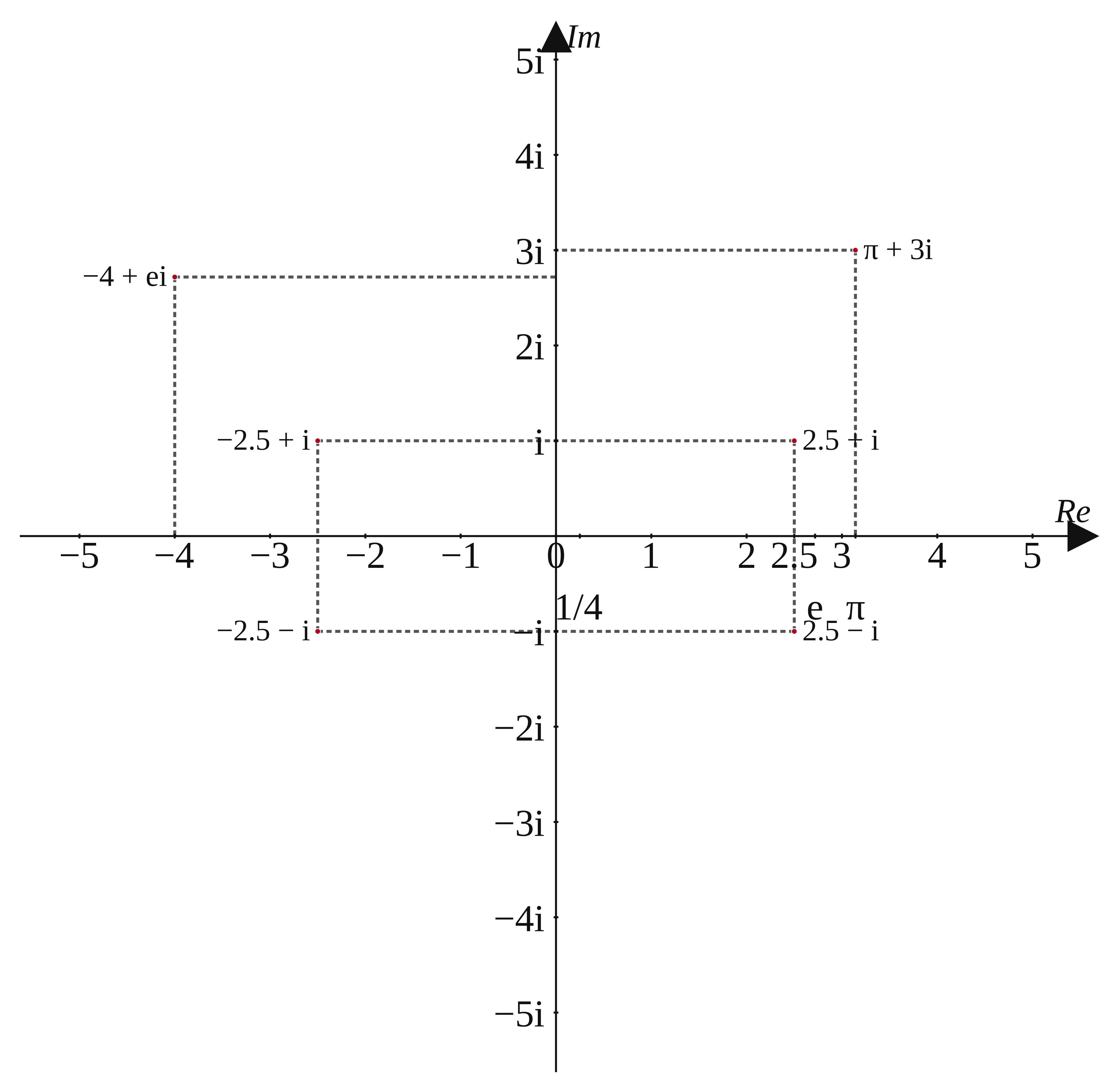
- Complex numbers $\mathbb{C}$: extension of real numbers to the complex plane to include imaginary numbers, such as $8i$
- e.g., $8+3i$, $7-5i$
All imaginary numbers are multiples of $i$, where $i=\sqrt{-1}$.
A complex number is the sum of a real number with an imaginary number. It has the general form $a+bi (a,b \in \mathbb{R})$
A complex plane is the coordinate plane of a real number axis and an imaginary number axis.

Every polynomial of degree $n$ has $n$ roots over the complex number set, i.e.,
$$ \forall a_n,a_{n-1},\ldots,a_0\in\mathbb{C},\ a_n\neq 0,\ \exists z_1,z_2,\ldots,z_n\in\mathbb{C}:\ \sum_{k=0}^{n} a_k z^k = 0 $$
Which is a direct result of the fundamental theorem of algebra.
In some classifications, real numbers are further classified into algebraic numbers $\mathbb{A}$, which is any real number that is a solution to a homogeneous polynomial equation with ratiaional coefficients. i.e.,
$$ x \in \mathbb{A} \iff \exists a_k \in \mathbb{Q}, \sum_{k=0}^{n \in N*} a_kx^k=0 $$
A non-algebraic real number is known as a transcendental number.