
Production: Difference between revisions
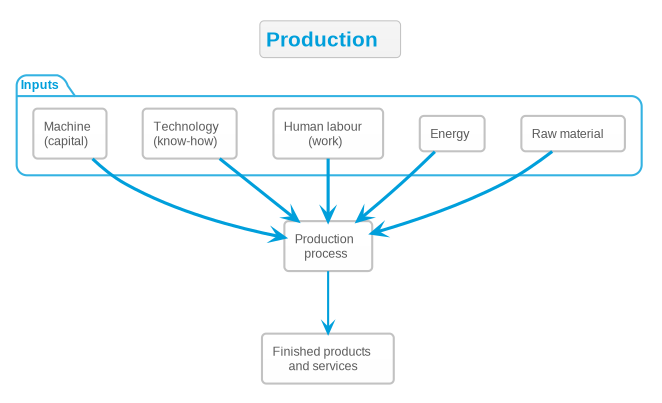
Created page with "Category:Production '''Production''' is the organised process of making goods and services on industrial scale.<ref>{{#cite:Q3286}}</ref> == Production process == <uml> @startuml !theme bluegray title Production skinparam defaultTextAlignment center package "Inputs" { rectangle "Raw material" as RM rectangle "Energy" as EN rectangle "Human labour\n(work)" as HL rectangle "Technology\n(know-how)" as TE rectangle "Machine\n(capital)" as MA } rectangle "Pr..." |
|||
| Line 29: | Line 29: | ||
@enduml | @enduml | ||
</uml> | </uml> | ||
== Production modes == | |||
{| class="wikitable" | |||
|- | |||
! Production mode | |||
! Application | |||
! Key challenges | |||
|- | |||
| Unitary production | |||
| Complex products with small demand quantity( e.g., airplanes, custom velomobile, pre-fabricated staircase) | |||
| Resource management: acquiring rapidly necessary resources when orders arrive without paying huge excess for storing everything all the time | |||
|- | |||
| Small batch production | |||
| Mass customisation (e.g., school uniforms), artisan food (e.g., bakery) | |||
| Optimising production, such reducing wait on high-demand machines and improving yield on raw material | |||
|- | |||
| mass production (frequently via an [[assembly line]] | |||
| Generic products with large demand quantity (e.g., lightbulbs, water bottles) | |||
| Synchronise different production steps to minimise waiting between different steps/optimise productivity/minimise cost | |||
|} | |||
<ref>{{#cite:Q3286}}</ref> | |||
Revision as of 14:22, 12 November 2026
Production is the organised process of making goods and services on industrial scale.[1]
Production process
Production modes
| Production mode | Application | Key challenges |
|---|---|---|
| Unitary production | Complex products with small demand quantity( e.g., airplanes, custom velomobile, pre-fabricated staircase) | Resource management: acquiring rapidly necessary resources when orders arrive without paying huge excess for storing everything all the time |
| Small batch production | Mass customisation (e.g., school uniforms), artisan food (e.g., bakery) | Optimising production, such reducing wait on high-demand machines and improving yield on raw material |
| mass production (frequently via an assembly line | Generic products with large demand quantity (e.g., lightbulbs, water bottles) | Synchronise different production steps to minimise waiting between different steps/optimise productivity/minimise cost |