HowItWorks:MediaWiki: Difference between revisions
No edit summary |
Enhance: fill Wiki engine section, add Page edit flow, expand Key design decisions into subsections (per HTML comments), fix 1.12 year (2008), refresh verified commands, add references. AI-assisted (RonzzWikiCowriter) (via update-page on MediaWiki MCP Server) |
||
| Line 1: | Line 1: | ||
{{HowItWorks}} | {{HowItWorks}} | ||
'''MediaWiki''' is the free, open-source wiki engine behind thousands of wiki instances, such as Wikipedia, Wikidata | '''MediaWiki''' is the free, open-source wiki engine behind thousands of wiki instances, such as Wikipedia, Wikidata — and this very site: RonzzWikiBase [5]. | ||
== | == What is a wiki engine? == | ||
A '''wiki engine''' is the software that runs a wiki: a website whose pages anyone can edit from their browser, with every change saved and reversible. The engine is the machinery behind that promise. It stores the pages in a database, shows the edit form, records each save as a new revision, and turns the stored text into the page the reader sees. | |||
MediaWiki is one such engine — written in PHP, backed by a relational database (MySQL or MariaDB by default) [1]. DokuWiki, MoinMoin and TiddlyWiki are other examples of the same idea. | |||
MediaWiki's origin sets it apart: it was built from the start to be Wikipedia's software [1]. Where a content-management system (CMS) usually has an editorial workflow and per-page access control, a wiki engine trusts its community instead. MediaWiki deliberately skips the usual CMS features, and puts its effort into the tools a live wiki needs: | |||
{| class="wikitable" | |||
! Wiki engine (MediaWiki) !! Typical CMS | |||
|- | |||
| no publication workflow — every edit is live immediately || editorial workflow and review [1] | |||
|- | |||
| no per-page access control (ACLs) || fine-grained roles and permissions [1] | |||
|- | |||
| built-in tools against spam and vandalism || focus on controlled publishing [1] | |||
|} | |||
The result is a system optimised for a very specific job: a community creating and curating knowledge on an open platform, at enormous scale [1]. | |||
== Components and interactions == | == Components and interactions == | ||
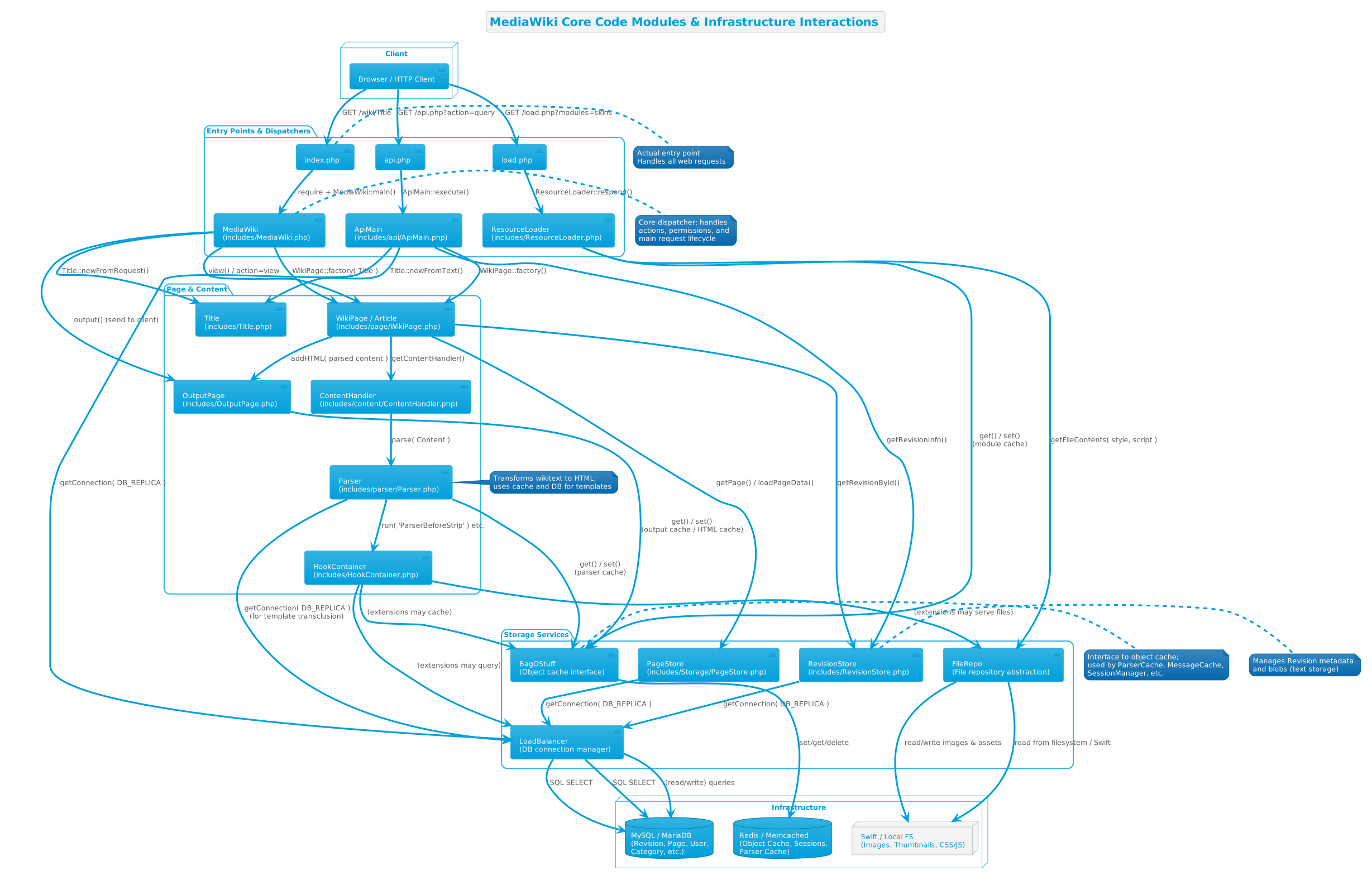
The diagram below is the map for the rest of this page. It shows MediaWiki's main building blocks — entry points, storage, the parser, caching — and how a request moves between them. | |||
<uml> | <uml> | ||
| Line 140: | Line 158: | ||
== MediaWiki in action == | == MediaWiki in action == | ||
Everything MediaWiki does reduces to two flows: '''reading''' a page and '''writing''' one. Both go through the same machinery. | |||
=== Page view === | === Page view === | ||
| Line 147: | Line 167: | ||
# '''The request arrives.''' The browser asks for <code>/wiki/Main_Page</code>. The web server hands it to PHP-FPM, which boots MediaWiki through <code>index.php</code>: security checks, default settings, then the site's own <code>LocalSettings.php</code>. | # '''The request arrives.''' The browser asks for <code>/wiki/Main_Page</code>. The web server hands it to PHP-FPM, which boots MediaWiki through <code>index.php</code>: security checks, default settings, then the site's own <code>LocalSettings.php</code>. | ||
# '''The title is resolved.''' MediaWiki works out which page is meant (namespace, redirects, aliases) and checks the reader's permissions. | # '''The title is resolved.''' MediaWiki works out which page is meant (namespace, redirects, aliases) and checks the reader's permissions. | ||
# '''The wikitext is loaded''' from the database — | # '''The wikitext is loaded''' from the database — MediaWiki stores the source text, not the rendered page [1]. | ||
# '''The preprocessor expands.''' Template calls (<syntaxhighlight lang="wikitext" inline>{{...}}</syntaxhighlight>), parser functions and magic words are resolved into expanded wikitext. This stage walks a tree and can skip dead branches, such as the unused cases of a <syntaxhighlight lang="wikitext" inline>{{#switch:…}}</syntaxhighlight>. | # '''The preprocessor expands.''' Template calls (<syntaxhighlight lang="wikitext" inline>{{...}}</syntaxhighlight>), parser functions and magic words are resolved into expanded wikitext. This stage walks a tree and can skip dead branches, such as the unused cases of a <syntaxhighlight lang="wikitext" inline>{{#switch:…}}</syntaxhighlight>. | ||
# '''The parser converts to HTML.''' Wikitext syntax becomes HTML elements; the Sanitizer class scrubs any raw HTML for unsafe content. | # '''The parser converts to HTML.''' Wikitext syntax becomes HTML elements; the Sanitizer class scrubs any raw HTML for unsafe content [1]. | ||
# '''The skin frames the page.''' The content HTML is wrapped in the skin's chrome (sidebar, header, footer) together with CSS and JavaScript delivered by ResourceLoader. | # '''The skin frames the page.''' The content HTML is wrapped in the skin's chrome (sidebar, header, footer) together with CSS and JavaScript delivered by ResourceLoader [1][3]. | ||
# '''The page is served.''' A repeat view can skip stages 4–6 entirely if the rendered output is still in a cache. | # '''The page is served.''' A repeat view can skip stages 4–6 entirely if the rendered output is still in a cache [1]. | ||
=== Page edit === | |||
An edit is the mirror image of a view: instead of reading a revision, it writes a new one. | |||
# '''The editor opens the page.''' Clicking "Edit" sends the stored wikitext — the source, not the rendered HTML — to the browser in a text box [1][4]. | |||
# '''The editor changes the text.''' "Show preview" runs the new wikitext through the parser and shows the result without saving; "Show changes" shows a diff against the current version [4]. An optional edit summary (up to 500 characters) describing the change is saved with the edit [4]. | |||
# '''The save is checked.''' MediaWiki compares the submitted text with the revision the editor started from. If someone else saved in between, the editor gets the edit-conflict screen and merges the two versions [6]. Changes to unrelated parts of the page are merged automatically [6]. | |||
# '''The revision is stored.''' The new text becomes a new revision: author, timestamp and summary are recorded, and the page's "latest" pointer moves to it [1]. The old revision stays — that is what makes history, diffs and undo possible. | |||
# '''The change spreads.''' The edit appears in the page history and in RecentChanges, and the page's cached output is discarded [1]. | |||
== Key design decisions == | == Key design decisions == | ||
Six choices explain why MediaWiki behaves the way it does. None is obvious; each trades a little simplicity for a lot of power. | |||
=== Content stays in wikitext, not HTML === | |||
MediaWiki stores pages as '''wikitext''' — a lightweight markup — and renders it to HTML only when a page is displayed [1]. Editors edit the source, and the source is what is stored. | |||
Why does that matter? | |||
* ''' | * '''Editing stays easy.''' Wikitext is plain text a human can read and write; raw HTML is verbose and error-prone [1]. | ||
* '''The parser is a stability contract | * '''The wiki stays re-renderable.''' Because the source is kept, the whole wiki can be re-parsed when the parser improves, a skin changes or a template is fixed. Nothing is ever frozen as HTML [1]. | ||
* '''History stays cheap.''' Every revision is stored as text, so any old version can be re-parsed and re-displayed — that is what makes diffs, rollback and undo work [1]. | |||
=== The parser is a stability contract === | |||
The '''parser''' turns wikitext into HTML, and MediaWiki treats its output as a promise: hundreds of millions of pages depend on it, so it changes slowly and conservatively [1]. | |||
The price is that wikitext never received a formal specification. It grew organically from the markup of an earlier engine, UseModWiki, so it cannot be described by a formal grammar — the unofficial spec is "whatever the parser spits out, plus a few hundred test cases" [1]. | |||
The clever part is how MediaWiki handles that constraint: it is building a second parser, '''Parsoid''', alongside the classic one. Parsoid converts wikitext to HTML and back, which is what powers the visual editor [1]. | |||
=== Templates are DRY for wikis === | |||
Templates let a wiki define something once and reuse it everywhere — a navigation box, a banner, an infobox. A page calls a template with <code><nowiki>{{Name}}</nowiki></code>, and its content is expanded into the page at read time [1]. | |||
For Wikipedia this was transformative: the same boilerplate used to be copied onto thousands of articles. Templates gained parameters in MediaWiki 1.3 and default values in 1.6, and users pushed them hard — building near-programming constructs with the <syntaxhighlight lang="wikitext" inline>{{#if:…}}</syntaxhighlight> and <syntaxhighlight lang="wikitext" inline>{{#switch:…}}</syntaxhighlight> parser functions [1]. | |||
The price was performance: template-heavy pages became slow to parse. MediaWiki's answer was a rewritten '''preprocessor''' in MediaWiki 1.12 (2008): it parses templates into a tree and skips the branches that are never used, such as the un-taken cases of a #switch [1][7]. Template-heavy pages got much faster, without any change to the markup. | |||
=== Skins separate content from presentation === | |||
A '''skin''' is the frame around the content: the header, footer and sidebar, plus the CSS and JavaScript that style them [3]. The parsed content HTML is the same under every skin; the skin decides how it is wrapped and presented. | |||
The consequence is elegant: re-skinning a site never touches the content. Readers choose their skin in their preferences — the default is Vector [3] — and this very site offers both Vector and Timeless [2]. The same parsed page renders under either, without re-parsing [1]. | |||
=== Extensions plug in; the core stays stable === | |||
MediaWiki's core is deliberately small; almost everything extra lives in '''extensions'''. They attach to the core through '''hooks''' — places where third-party code can run before, after, or instead of MediaWiki's own behaviour for a given event [1]. Some hooks even let an extension add new wikitext syntax of its own [1]. | |||
This was not always so. Before hooks arrived in 2004, customising MediaWiki meant editing the core — fragile and hard to maintain [1]. The hook system turned that into a supported plug-in mechanism. | |||
On this very site the pattern is visible: Cite, SyntaxHighlight, Wikibase — and Ronzz's own EmbeddableContent and WikibaseCitation — are all extensions, not forks [2]. | |||
=== Caching is the price of PHP === | |||
Every request boots PHP from scratch, so a busy wiki would be slow without help. MediaWiki answers with layers of caches [1]: | |||
{| class="wikitable" | |||
! Layer !! What it stores !! Effect | |||
|- | |||
| Reverse proxy (CDN) || whole rendered pages || serves anonymous readers without booting PHP at all; most requests never reach the application servers [1] | |||
|- | |||
| Object cache (Memcached / Redis) || parsed page output || avoids re-parsing the same wikitext [1] | |||
|- | |||
| Opcode cache || compiled PHP || skips recompiling scripts on every request [1] | |||
|} | |||
The clever part is that MediaWiki does not merely sit behind these caches — it tells them what to forget. When a page changes, MediaWiki purges it from the caches; when a template changes, every page that uses it is invalidated [1]. Correct invalidation is the hard part, and getting it right is what lets a constantly-edited site like Wikipedia be served from cache. | |||
== Try it yourself == | == Try it yourself == | ||
All commands below were verified to work at the time of writing (2026-08) against this wiki (MediaWiki 1.46.0). | All commands below were verified to work at the time of writing (2026-08-28) against this wiki (MediaWiki 1.46.0 [2]). | ||
<syntaxhighlight lang="bash" copy> | <syntaxhighlight lang="bash" copy> | ||
| Line 190: | Line 266: | ||
<syntaxhighlight lang="text" copy> | <syntaxhighlight lang="text" copy> | ||
<p><strong>Hi, welcome to | <p><strong>Hi, welcome to ronzz.ORG's wikibase. | ||
</syntaxhighlight> | |||
<syntaxhighlight lang="bash" copy> | |||
# Preview without saving: run a snippet of wikitext through the parser | |||
curl -sG "https://wikibase.ronzz.org/api.php" --data-urlencode "action=parse" --data-urlencode "text='''Bold''' and ''italic''" --data-urlencode "format=json" | grep -o "<b>.*</i>" | |||
</syntaxhighlight> | |||
Output: | |||
<syntaxhighlight lang="text" copy> | |||
<b>Bold</b> and <i>italic</i> | |||
</syntaxhighlight> | |||
<syntaxhighlight lang="bash" copy> | |||
# Every edit leaves a trace: the last three revisions of Main Page | |||
curl -s "https://wikibase.ronzz.org/api.php?action=query&prop=revisions&titles=Main_Page&rvprop=timestamp%7Cuser&rvlimit=3&format=json" | grep -oE '"user":"[^"]*"|"timestamp":"[^"]*"' | |||
</syntaxhighlight> | |||
Output: | |||
<syntaxhighlight lang="text" copy> | |||
"user":"Rongzhou" | |||
"timestamp":"2026-08-24T14:55:13Z" | |||
"user":"Rongzhou" | |||
"timestamp":"2026-08-21T06:08:37Z" | |||
"user":"Rongzhou" | |||
"timestamp":"2026-08-19T18:59:55Z" | |||
</syntaxhighlight> | </syntaxhighlight> | ||
| Line 196: | Line 299: | ||
* paste <code><nowiki>{{HowItWorks}}</nowiki></code> into the input box and click "Expand" — | * paste <code><nowiki>{{HowItWorks}}</nowiki></code> into the input box and click "Expand" — | ||
* | * you see the expanded wikitext, before the parser turns it into HTML. | ||
== References == | |||
# [https://www.mediawiki.org/wiki/Manual:MediaWiki_architecture Manual:MediaWiki architecture] — the architecture deep-dive on mediawiki.org | |||
# [https://wikibase.ronzz.org/api.php?action=query&meta=siteinfo&siprop=general%7Cextensions&format=json This wiki's siteinfo API] — version, PHP and database, extension list (fetched 2026-08-28) | |||
# [https://www.mediawiki.org/wiki/Manual:Skins Manual:Skins] — skins documentation | |||
# [https://www.mediawiki.org/wiki/Help:Editing_pages Help:Editing pages] — user documentation for editing | |||
# [https://www.mediawiki.org/wiki/MediaWiki MediaWiki] — the software project page | |||
# [https://www.mediawiki.org/wiki/Help:Edit_conflict Help:Edit conflict] — how conflicts are detected and resolved | |||
# [https://www.mediawiki.org/wiki/Release_notes/1.12 Release notes/1.12] — the preprocessor rewrite | |||
# [https://wikibase.ronzz.org/api.php?action=query&prop=revisions&titles=Main_Page&rvprop=ids%7Ctimestamp%7Cuser%7Ccomment&rvlimit=3&format=json Revisions query (ids|timestamp|user|comment)] — verified 2026-08-28 | |||
# [https://wikibase.ronzz.org/api.php?action=parse&page=Main_Page&format=json Parse API for Main Page] — verified 2026-08-28 | |||
# [https://wikibase.ronzz.org/api.php?action=parse&text=%27%27%27Bold%27%27%27%20and%20%27%27italic%27%27&prop=text&format=json Parse API with raw text] — verified 2026-08-28 | |||
# [https://wikibase.ronzz.org/api.php?action=query&prop=revisions&titles=Main_Page&rvprop=timestamp%7Cuser&rvlimit=3&format=json Revisions query (timestamp|user)] — verified 2026-08-28 | |||
== Further reading == | == Further reading == | ||
| Line 205: | Line 322: | ||
The reference layer for this site's own data lives in the [[Cheatsheets:SPARQL|SPARQL cheatsheet]]: the sheet is the syntax, this page is the machinery. | The reference layer for this site's own data lives in the [[Cheatsheets:SPARQL|SPARQL cheatsheet]]: the sheet is the syntax, this page is the machinery. | ||
Wiki: wikibase.ronzz.org | |||
Revision as of 08:57, 28 August 2026
Explains how things actually work — part of our technology dissections collection.
MediaWiki is the free, open-source wiki engine behind thousands of wiki instances, such as Wikipedia, Wikidata — and this very site: RonzzWikiBase [5].
What is a wiki engine?
A wiki engine is the software that runs a wiki: a website whose pages anyone can edit from their browser, with every change saved and reversible. The engine is the machinery behind that promise. It stores the pages in a database, shows the edit form, records each save as a new revision, and turns the stored text into the page the reader sees.
MediaWiki is one such engine — written in PHP, backed by a relational database (MySQL or MariaDB by default) [1]. DokuWiki, MoinMoin and TiddlyWiki are other examples of the same idea.
MediaWiki's origin sets it apart: it was built from the start to be Wikipedia's software [1]. Where a content-management system (CMS) usually has an editorial workflow and per-page access control, a wiki engine trusts its community instead. MediaWiki deliberately skips the usual CMS features, and puts its effort into the tools a live wiki needs:
| Wiki engine (MediaWiki) | Typical CMS |
|---|---|
| no publication workflow — every edit is live immediately | editorial workflow and review [1] |
| no per-page access control (ACLs) | fine-grained roles and permissions [1] |
| built-in tools against spam and vandalism | focus on controlled publishing [1] |
The result is a system optimised for a very specific job: a community creating and curating knowledge on an open platform, at enormous scale [1].
Components and interactions
The diagram below is the map for the rest of this page. It shows MediaWiki's main building blocks — entry points, storage, the parser, caching — and how a request moves between them.
MediaWiki in action
Everything MediaWiki does reduces to two flows: reading a page and writing one. Both go through the same machinery.
Page view
A page view passes through these stages:
- The request arrives. The browser asks for
/wiki/Main_Page. The web server hands it to PHP-FPM, which boots MediaWiki throughindex.php: security checks, default settings, then the site's ownLocalSettings.php. - The title is resolved. MediaWiki works out which page is meant (namespace, redirects, aliases) and checks the reader's permissions.
- The wikitext is loaded from the database — MediaWiki stores the source text, not the rendered page [1].
- The preprocessor expands. Template calls (
{{...}}), parser functions and magic words are resolved into expanded wikitext. This stage walks a tree and can skip dead branches, such as the unused cases of a{{#switch:…}}. - The parser converts to HTML. Wikitext syntax becomes HTML elements; the Sanitizer class scrubs any raw HTML for unsafe content [1].
- The skin frames the page. The content HTML is wrapped in the skin's chrome (sidebar, header, footer) together with CSS and JavaScript delivered by ResourceLoader [1][3].
- The page is served. A repeat view can skip stages 4–6 entirely if the rendered output is still in a cache [1].
Page edit
An edit is the mirror image of a view: instead of reading a revision, it writes a new one.
- The editor opens the page. Clicking "Edit" sends the stored wikitext — the source, not the rendered HTML — to the browser in a text box [1][4].
- The editor changes the text. "Show preview" runs the new wikitext through the parser and shows the result without saving; "Show changes" shows a diff against the current version [4]. An optional edit summary (up to 500 characters) describing the change is saved with the edit [4].
- The save is checked. MediaWiki compares the submitted text with the revision the editor started from. If someone else saved in between, the editor gets the edit-conflict screen and merges the two versions [6]. Changes to unrelated parts of the page are merged automatically [6].
- The revision is stored. The new text becomes a new revision: author, timestamp and summary are recorded, and the page's "latest" pointer moves to it [1]. The old revision stays — that is what makes history, diffs and undo possible.
- The change spreads. The edit appears in the page history and in RecentChanges, and the page's cached output is discarded [1].
Key design decisions
Six choices explain why MediaWiki behaves the way it does. None is obvious; each trades a little simplicity for a lot of power.
Content stays in wikitext, not HTML
MediaWiki stores pages as wikitext — a lightweight markup — and renders it to HTML only when a page is displayed [1]. Editors edit the source, and the source is what is stored.
Why does that matter?
- Editing stays easy. Wikitext is plain text a human can read and write; raw HTML is verbose and error-prone [1].
- The wiki stays re-renderable. Because the source is kept, the whole wiki can be re-parsed when the parser improves, a skin changes or a template is fixed. Nothing is ever frozen as HTML [1].
- History stays cheap. Every revision is stored as text, so any old version can be re-parsed and re-displayed — that is what makes diffs, rollback and undo work [1].
The parser is a stability contract
The parser turns wikitext into HTML, and MediaWiki treats its output as a promise: hundreds of millions of pages depend on it, so it changes slowly and conservatively [1].
The price is that wikitext never received a formal specification. It grew organically from the markup of an earlier engine, UseModWiki, so it cannot be described by a formal grammar — the unofficial spec is "whatever the parser spits out, plus a few hundred test cases" [1].
The clever part is how MediaWiki handles that constraint: it is building a second parser, Parsoid, alongside the classic one. Parsoid converts wikitext to HTML and back, which is what powers the visual editor [1].
Templates are DRY for wikis
Templates let a wiki define something once and reuse it everywhere — a navigation box, a banner, an infobox. A page calls a template with {{Name}}, and its content is expanded into the page at read time [1].
For Wikipedia this was transformative: the same boilerplate used to be copied onto thousands of articles. Templates gained parameters in MediaWiki 1.3 and default values in 1.6, and users pushed them hard — building near-programming constructs with the {{#if:…}} and {{#switch:…}} parser functions [1].
The price was performance: template-heavy pages became slow to parse. MediaWiki's answer was a rewritten preprocessor in MediaWiki 1.12 (2008): it parses templates into a tree and skips the branches that are never used, such as the un-taken cases of a #switch [1][7]. Template-heavy pages got much faster, without any change to the markup.
Skins separate content from presentation
A skin is the frame around the content: the header, footer and sidebar, plus the CSS and JavaScript that style them [3]. The parsed content HTML is the same under every skin; the skin decides how it is wrapped and presented.
The consequence is elegant: re-skinning a site never touches the content. Readers choose their skin in their preferences — the default is Vector [3] — and this very site offers both Vector and Timeless [2]. The same parsed page renders under either, without re-parsing [1].
Extensions plug in; the core stays stable
MediaWiki's core is deliberately small; almost everything extra lives in extensions. They attach to the core through hooks — places where third-party code can run before, after, or instead of MediaWiki's own behaviour for a given event [1]. Some hooks even let an extension add new wikitext syntax of its own [1].
This was not always so. Before hooks arrived in 2004, customising MediaWiki meant editing the core — fragile and hard to maintain [1]. The hook system turned that into a supported plug-in mechanism.
On this very site the pattern is visible: Cite, SyntaxHighlight, Wikibase — and Ronzz's own EmbeddableContent and WikibaseCitation — are all extensions, not forks [2].
Caching is the price of PHP
Every request boots PHP from scratch, so a busy wiki would be slow without help. MediaWiki answers with layers of caches [1]:
| Layer | What it stores | Effect |
|---|---|---|
| Reverse proxy (CDN) | whole rendered pages | serves anonymous readers without booting PHP at all; most requests never reach the application servers [1] |
| Object cache (Memcached / Redis) | parsed page output | avoids re-parsing the same wikitext [1] |
| Opcode cache | compiled PHP | skips recompiling scripts on every request [1] |
The clever part is that MediaWiki does not merely sit behind these caches — it tells them what to forget. When a page changes, MediaWiki purges it from the caches; when a template changes, every page that uses it is invalidated [1]. Correct invalidation is the hard part, and getting it right is what lets a constantly-edited site like Wikipedia be served from cache.
Try it yourself
All commands below were verified to work at the time of writing (2026-08-28) against this wiki (MediaWiki 1.46.0 [2]).
# Which version is this wiki running?
curl -s "https://wikibase.ronzz.org/api.php?action=query&meta=siteinfo&siprop=general&format=json" | grep -o '"generator":"[^"]*"'
Output:
"generator":"MediaWiki 1.46.0"
# See the parser's HTML output for a page (the raw pipeline result, before the skin)
curl -s "https://wikibase.ronzz.org/api.php?action=parse&page=Main_Page&format=json" | grep -o "<p><strong>[^<]*"
Output:
<p><strong>Hi, welcome to ronzz.ORG's wikibase.
# Preview without saving: run a snippet of wikitext through the parser
curl -sG "https://wikibase.ronzz.org/api.php" --data-urlencode "action=parse" --data-urlencode "text='''Bold''' and ''italic''" --data-urlencode "format=json" | grep -o "<b>.*</i>"
Output:
<b>Bold</b> and <i>italic</i>
# Every edit leaves a trace: the last three revisions of Main Page
curl -s "https://wikibase.ronzz.org/api.php?action=query&prop=revisions&titles=Main_Page&rvprop=timestamp%7Cuser&rvlimit=3&format=json" | grep -oE '"user":"[^"]*"|"timestamp":"[^"]*"'
Output:
"user":"Rongzhou"
"timestamp":"2026-08-24T14:55:13Z"
"user":"Rongzhou"
"timestamp":"2026-08-21T06:08:37Z"
"user":"Rongzhou"
"timestamp":"2026-08-19T18:59:55Z"
See the preprocessor stage directly: Visit Special:ExpandTemplates
- paste
{{HowItWorks}}into the input box and click "Expand" — - you see the expanded wikitext, before the parser turns it into HTML.
References
- Manual:MediaWiki architecture — the architecture deep-dive on mediawiki.org
- This wiki's siteinfo API — version, PHP and database, extension list (fetched 2026-08-28)
- Manual:Skins — skins documentation
- Help:Editing pages — user documentation for editing
- MediaWiki — the software project page
- Help:Edit conflict — how conflicts are detected and resolved
- Release notes/1.12 — the preprocessor rewrite
- Revisions query (ids|timestamp|user|comment) — verified 2026-08-28
- Parse API for Main Page — verified 2026-08-28
- Parse API with raw text — verified 2026-08-28
- Revisions query (timestamp|user) — verified 2026-08-28
Further reading
- Manual:MediaWiki architecture — the canonical architecture deep-dive (also a chapter of the Architecture of Open Source Applications book)
- Manual:Contents — the technical manual of the software
- MediaWiki — the software project page
The reference layer for this site's own data lives in the SPARQL cheatsheet: the sheet is the syntax, this page is the machinery.
Wiki: wikibase.ronzz.org