
Cosmic microwave background
The cosmic microwave background (CMB) is a faint electromagnetic radiation that permeates the entire Universe. It is a relic of the hot, dense, and nearly uniform state in which the universe began about 13.8 billion years ago.[1]
Released when the Universe had cooled enough to become transparent, a few hundred thousand years after the Big Bang, The CMB is the most ancient light that can be observed today from earth.
Because of redshift caused by cosmic expansion, the wavelength ($\lambda$) of the CMB is streched by a factor of about 1100. Hence, CMB observed today from earth falls into the microwave spectrum, and can be modelled as a near-perfect blackbody at a temperature of about 2.7 kelvin.[2]
With modern technologies, the spectrum and spatial pattern of the CMB can be measured with exquisite precision: It has become arguably the most informative observable in modern cosmology. Tiny variations on the scale of $10^{-5}$ provide valuable hints on the geometry, composition, age and history of the entire Universe. CMB is today the strongest evidence that the universe is spatially flat, and dark matter and dark energy dominate the Universe at present time.[1]
History
1940s: Prediction
In the 1940s, George Gamow and collaborators demonstrated that if the Universe began in an enormously hot and dense state as suggested by the Hot Big Bang Model, the Universe today should still be filled with radiation left over from that era.
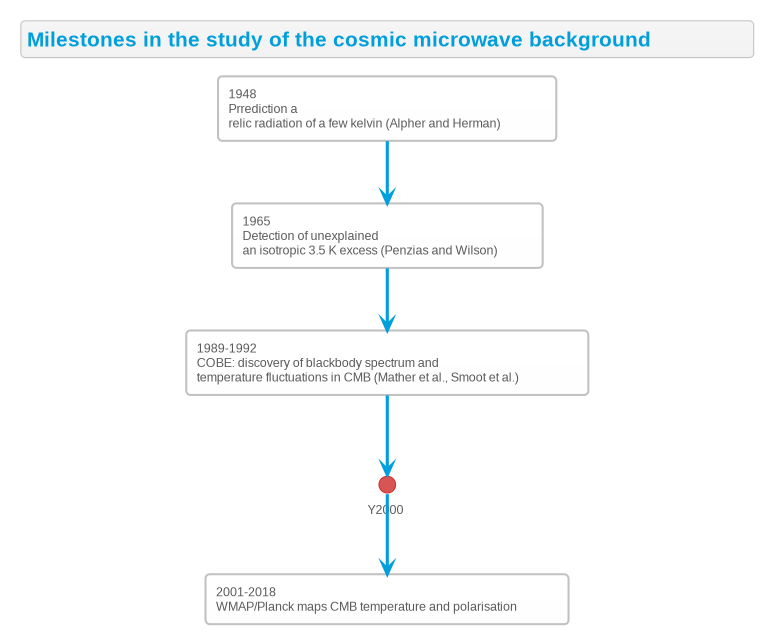
Ralph Asher Alpher and Robert Herman further estimated that taking into account the cooling provided by an expanding Universe, the temperature of this relic radiation should be only a few kelvins.[3] The prediction attracted little attention at the time, and the observation of the radiation was not actively searched for.
1960s: Accidental discovery
In the early 1960s, a group of physicists led by Robert H. Dicke at Princeton University revisited the idea of the relic radiation and built a small radiometer to search for it.
Their progress, however, was ironically superseded by two telecommunication engineers who had no idea of the existence of this relic radiation.

In 1964 and 1965, Arno Penzias and Robert Woodrow Wilson, both doctors of philosophy in physics and working as telecommunication research engineers at Bell Telephone Laboratories, were manipulating a $6m$ horn-reflector antenna in Holmdel, New Jersey to measure the faint radio emission of the Milky Way to characterise the noise sources that would interfere with satelite communications.
For the most part, Penzias and Wilson successfully attributed detected noises to the atmosphere, human activity, and limitations of their own apparatus. However, at $\lambda = 7.35 \mathrm{cm}$ they detected a faint isotropic noise, present regardless of the antenna's orientation and time of day.[4]
The pair eliminated every source of noise they could think of, going as far as murdering a pair of pigeons that had taken up residence in the antenna and cleaning away the "white dielectric material" they had left behind, yet the unidentified noise remained.
In early 1965, during a casual conversation with his friend Bernard F. Burke, a radio astronomer at MIT on an unrelated subject, Penzias was asked on his research's progress, and he mentioned the puzzling persistent noise at $\lambda=7.35 \mathrm{cm}$. Burke, who had just returned from a conference, where he heard about the attempt at Princeton to detect CMB, recognised that what Penzia had stumbled upon may actually be the elusive cosmic relic radiation that the physicists at Princeton were chasing hard behind. He immediately put Penzias in contact with Dicke, the lead scientist of the Princeton group.
Upon visiting Holmdel, the Princeton physicists became convinced that the mysterious isotropic noise Penzias and Wilson detected with their ultra-sensitive antenna was the cosmic relic radiation that their own home-built radiometer attempted and failed to detect. The two teams agreed to coordinate the publishing of their findings. Penzias and Wilson reported the measurement in a short, deliberately understated paper, "A Measurement of Excess Antenna Temperature at 4080 Mc/s¹";[4] the Princeton group supplied the cosmological interpretation, "Cosmic Black-Body Radiation²", which appeared immediately before it in the same issue of The Astrophysical Journal.[5]
1: 4080 Mc/s is the frequency corresponding to $\lambda=7.35 \mathrm{cm}$.
2: The CMB was characterised as an excess antenna temperature/cosmic black-body radiation as the radiowaves received by the antenna Penzias and Wilson were manipulating is consistent with radiations from a $T=3.5K$ black body.
Arno Penzias and Robert Woodrow Wilson shared the 1978 Nobel Prize in Physics for their accidental ground-breaking discovery.
Since 1980s: Measuring the spectrum and the fluctuations
COBE and 2 landmark discoveries

In 1989, NASA launched its Cosmic Background Explorer (COBE) satellite, equipped with 3 instruments dedicated to the study of the CMB:
- the Far-Infrared Absolute Spectrophotometer (FIRAS), designed to measure the frequency spectrum of the CMB at millimetre and submillimetre wavelengths, with a built-in internal blackbody reference for comparison with a perfect blackbody;
- the Differential Microwave Radiometer (DMR), which compared the temperature of the CMB in two beams separated by $60^\circ$, at frequencies of 31, 53 and 90 GHz to identify tiny spatial temperature fluctuations of the CMB;
- the Diffuse Infrared Background Experiment (DIRBE), which mapped the diffuse infrared background of the Universe as observed from earth, complementing the CMB measurements at shorter wavelengths.
The analysis of data collected by COBE led to two landmark conclusions.
- CMB can be modelled as radiation from a near-perfect blackbody, with deviations on the scale of $10^{-5}$, consistent with expectations for relic radiations from a hot, dense, thermalised early Universe. (Mather et al.).[2]
- Spatial temperature fluctuations in the CMB can be detected on the scale of $10^{-5}$ from the mean temperature(Smoot et al.), consistent with the small density fluctuations required by the Hot Big Bang Model for formation of stars and galaxies via graviational interactions.[6]
John C. Mather and George F. Smoot shared the 2006 Nobel Prize in Physics for their landmark discoveries.
WMAP and Planck

Two subsequent space missions, NASA's Wilkinson Microwave Anisotropy Probe (WMAP), launched in 2001, and ESA's Planck satellite, launched in 2009, mapped the temperature and polarisation of the CMB over the entire celestial sphere with far higher sensitivity and resolution than COBE, which allowed precise determinations of the age and dark energy density of the Universe.[1]
Origin and physical properties
The surface of last scattering
In the hot early Universe, matter was ionised: free protons and electrons formed a plasma that scattered photons almost continuously.
As the early Universe was dense, radiation was tightly coupled to matter, and photons could not travel freely. However, the Universe cooled as it expanded. About 380,000 years after the Big Bang, the temperature of the universe fell to about 3000K , and the free electrons combined with protons to form neutral hydrogen in a process known as recombination, and the scattering of the photons stopped.
With the cooling the density of the Universe also decreased, allowing for the photons scattered before recombination to travel freely in whatever direction the cosmic plasma had last scattered it just before recombination. A proportion of those photons eventually reaches earth, forming the basis of the cosmic microwave background observed today.
References
- ↑ ↑ ↑ Planck Collaboration. (2020). Planck 2018 results. Astronomy and Astrophysics, 641, A6. https://doi.org/10.1051/0004-6361/201833910
- ↑ ↑ Mather, J. C. (2007). Nobel Lecture: From the Big Bang to the Nobel Prize and beyond. Reviews of Modern Physics, 79(4), 1331–1348. https://doi.org/10.1103/RevModPhys.79.1331
- ↑ Alpher, R. A., & Herman, R. (1948). On the Relative Abundance of the Elements. Physical Review, 74. https://doi.org/10.1103/PhysRev.74.1737
- ↑ ↑ Penzias, A., & Wilson, R. W. (1965). A Measurement of Excess Antenna Temperature at 4080 Mc/s. The Astrophysical Journal, 142(1), 419–421. https://doi.org/10.1086/148307
- ↑ Dicke, R. H., Peebles, P. J. E., Roll, P. G., & Wilkinson, D. T. (1965). Cosmic Black-Body Radiation. The Astrophysical Journal, 142, 414–419. https://doi.org/10.1086/148306
- ↑ Smoot, G. F. (2007). Nobel Lecture: Cosmic microwave background radiation anisotropies: Their discovery and utilization. Reviews of Modern Physics, 79(4), 1349–1379. https://doi.org/10.1103/RevModPhys.79.1349
Further reading
- The Universe, NASA Science
- Wilkinson Microwave Anisotropy Probe, NASA
- Planck, European Space Agency
- Planck 2018 results. VI. Cosmological parameters, Planck Collaboration (2020)