HowItWorks:MediaWiki
Explains how things actually work — part of our technology dissections collection.
MediaWiki is the free, open-source wiki engine behind Wikipedia, Wikidata — and this very site.
Components and interactions
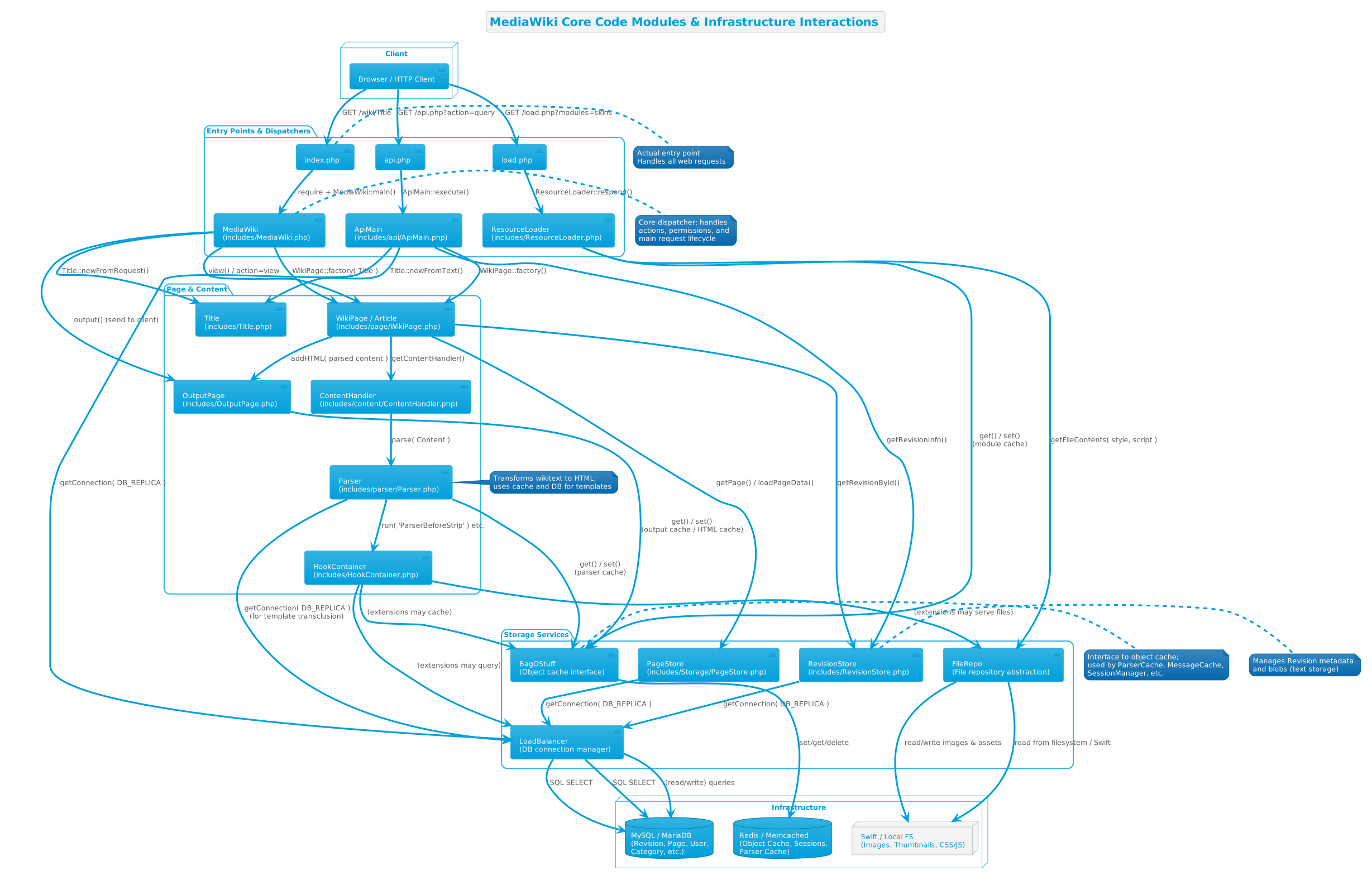
MediaWiki in action
Page view
A page view passes through these stages:
- The request arrives. The browser asks for
/wiki/Main_Page. The web server hands it to PHP-FPM, which boots MediaWiki throughindex.php: security checks, default settings, then the site's ownLocalSettings.php. - The title is resolved. MediaWiki works out which page is meant (namespace, redirects, aliases) and checks the reader's permissions.
- The wikitext is loaded from the database — always the stored source, never a pre-rendered copy.
- The preprocessor expands. Template calls (
{{...}}), parser functions and magic words are resolved into expanded wikitext. This stage walks a tree and can skip dead branches, such as the unused cases of a{{#switch:…}}. - The parser converts to HTML. Wikitext syntax becomes HTML elements; the Sanitizer class scrubs any raw HTML for unsafe content.
- The skin frames the page. The content HTML is wrapped in the skin's chrome (sidebar, header, footer) together with CSS and JavaScript delivered by ResourceLoader.
- The page is served. A repeat view can skip stages 4–6 entirely if the rendered output is still in a cache.
Key design decisions
- Content stays in wikitext, not HTML.
- The parser is a stability contract. Hundreds of millions of pages depend on its output, so it changes slowly and conservatively. The price: wikitext grew organically, is complex, and cannot be described by a formal grammar.
- Templates are DRY for wikis. One source of truth for repeated boilerplate (navigation boxes, banners, infoboxes), expanded at read time.
- The preprocessor rewrite (MediaWiki 1.12, 2009) exists precisely because template-heavy pages had become a parsing bottleneck.
- Skins separate content from presentation. The same content HTML renders under any skin without re-parsing.
- Extensions plug in; the core stays stable. Hooks let third-party code run before, after or instead of core behaviour — the citation and embed systems on this very site are extensions, not forks.
- Caching is the price of PHP. Every request boots PHP, so MediaWiki layers caches: reverse proxies serve whole pages, an object cache avoids re-parsing, an opcode cache skips recompiling PHP. The tradeoff is cache invalidation (next section).
Diagram
| Stage | What happens |
|---|---|
| preprocessor | {{templates}}, {{#if:…}}, magic words → expanded wikitext
|
| parser | expanded wikitext → HTML (via Sanitizer) |
| skin | content HTML + chrome + ResourceLoader CSS/JS → complete page |
| cache | the complete page is stored; repeat views skip the stages above |
Gotchas & myths
"MediaWiki is a CMS like WordPress."
Myth Reality publication workflows, per-namespace access control, WYSIWYG-first editing a wiki engine: open editing, per-action permissions, a stable text markup. The visual editor is an extension, and access control beyond "everyone can edit" is not the default.
"Editing wikitext is editing HTML."
Myth Reality <script>alert(1)</script>would runraw HTML is only allowed in limited forms; the Sanitizer strips anything unsafe — a <script>tag never survives into the page.
"A template change instantly updates every page using it."
Myth Reality save the template → all pages render the new output immediately transclusion happens at parse time; already-cached pages keep the old rendering until their cache is invalidated. A widespread template change can need a purge or a cache clear.
"Every page view runs PHP and re-parses the page."
Myth Reality PHP boots and the full pipeline runs for every hit cached pages short-circuit before the application; only uncached requests run the full pipeline.
Try it yourself
All commands below were run live against this wiki (MediaWiki 1.46.0) while writing this page.
# Which version is this wiki running?
curl -s "https://wikibase.ronzz.org/api.php?action=query&meta=siteinfo&siprop=general&format=json" | grep -o '"generator":"[^"]*"'
Verified output:
"generator":"MediaWiki 1.46.0"
# See the parser's HTML output for a page (the raw pipeline result, before the skin)
curl -s "https://wikibase.ronzz.org/api.php?action=parse&page=Main_Page&format=json" | grep -o "<p><strong>[^<]*"
Verified output:
<p><strong>Hi, welcome to Ronzz.org's own wikibase.
# See the preprocessor stage directly: Special:ExpandTemplates
#   https://wikibase.ronzz.org/wiki/Special:ExpandTemplates
# paste {{HowItWorks}} into the input box and click "Expand" —
# you see the expanded wikitext before the parser turns it into HTML.
Further reading
- Manual:MediaWiki architecture — the canonical architecture deep-dive (also a chapter of the Architecture of Open Source Applications book)
- Manual:Contents — the technical manual of the software
- MediaWiki — the software project page
The reference layer for this site's own data lives in the SPARQL cheatsheet: the sheet is the syntax, this page is the machinery.