Dark matter
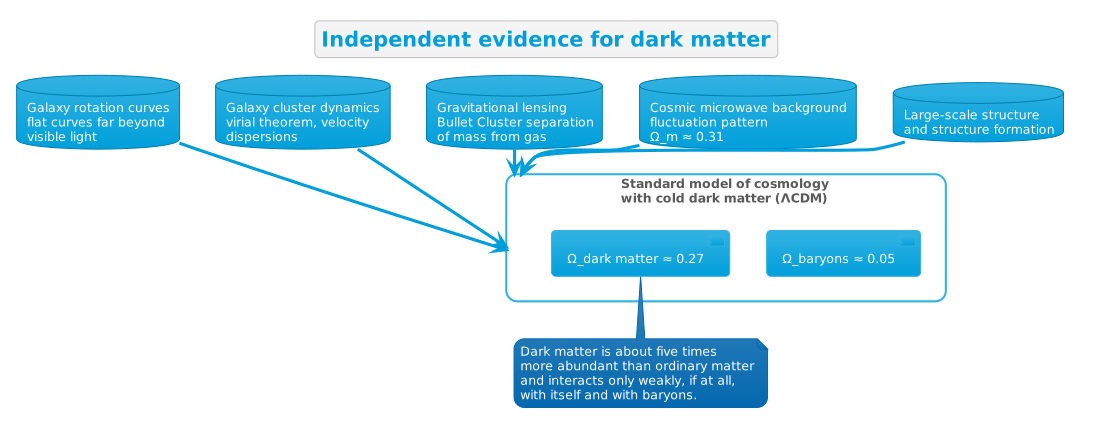
Dark matter is a theorised form of matter that accounts for 27% of the content of the universe in [[the standard model of cosmology. It does not interact with the electromagnetic spectrum at all, which means it neither absorbs, reflects nor emits light. As such, it cannot be observed directly, hence the name "dark".[1][2]
The existence of dark matter is inferred from its gravitational effects on visible matter, radiation and the structure of the universe.[1] Dark matter shapes the cosmos, organising galaxies and larger structures that would otherwise fly apart under their own rotation or expansion.[1] It is thought to be the invisible glue that holds galaxies and galaxy clusters together, outweighing the visible stars and gas in most systems.[1]
.jpg)
As of 2026, there is currently no observed evidence of an interaction between dark and ordinary matter through any force other than gravity.
History
Zwicky and the Coma cluster (1933)
The modern concept of dark matter took shape in the early 1930s. In 1933, Swiss astronomer Fritz Zwicky applied the virial theorem to the Coma cluster, a large cluster of galaxies.[3][1] By measuring how fast the individual galaxies move within the cluster, he estimated its total mass and compared it with the mass of the visible galaxies.
Zwicky found that the galaxies in the Coma cluster were moving far too quickly for the gravity of the visible matter to hold the cluster together: the galaxies should have been escaping, yet the cluster remained bound. He concluded that a vast amount of invisible matter must be present to supply the missing gravity, and he dubbed this material dunkle Materie, German for "dark matter".[1][3] His estimate implied a mass-to-light ratio of several hundred solar masses per solar luminosity, far above what the stars alone could provide.
At the time, Zwicky's revolutionary theory was regarded as fringe, as it rested on observational evidence on just a handful of galaxies.[1]
Rotation curves of spiral galaxies
American astronomer Vera Rubin and her collaborator W. Kent Ford Jr. revisited Zwicky's theory in the 1970-80s, and found more convincing evidence of the existence of dark matter via observing the orbit of stars and gas clouds in spiral galaxies.
Newtonian gravity, applied at planetary scale, stipulates that speed through the mass enclosed within the orbit:
where G is the gravitational constant, M(r) the mass enclosed within radius r, and vc(r) the circular orbital speed at that radius.
If the mass traced the light, the rotation curve would rise in the inner galaxy and then fall off as the stars thinned out. However, in their landmark 1980 study of 21 Sc spiral galaxies, from the small NGC 4605 (radius 4 kpc) to the giant UGC 2885 (radius 122 kpc), Rubin and Ford observed instead that the rotation curves of stars and gas clouds stayed flat to the last measured point in every galaxy: those at the outskirts of the galaxies orbited just as fast as those near the centre, far beyond the point where the visible light faded.[4] The only way to reconcile the flat curves with Newtonian gravity was to suppose that each spiral galaxy sits inside a large, roughly spherical halo of invisible matter whose mass continues to grow well beyond the visible disk.
.png)
Rubin's work provided such strong evidence that the existence of dark matter became widely accepted.[1]

The physics of dark matter
The abundance of dark matter is normally expressed relative to the critical density, the density that would just halt the expansion of a flat universe:
where H is the Hubble parameter and G the gravitational constant. Each cosmic component is then described by its density parameter:
with the matter density parameter Ωm comprising the baryonic and the dark matter contributions.
Cosmological observations, most precisely from the cosmic microwave background, hence shows
Which means that roughly 27% of the universe, or about 85% of all matter, is dark matter. As such only about 5% of the universe is ordinary baryonic matter.[2]
Whatever dark matter is, it must be very different from the matter of the periodic table. It does not clump into stars or gas clouds, it does not collide and dissipate energy as ordinary gas does, and it interacts with itself and with ordinary matter at most very weakly. Simulations of cosmic structure formation show that only "cold" dark matter, made of slow-moving particles that gathered into clumps in the early universe, produces the web of galaxies and clusters actually observed; "warm" or "hot" dark matter made of faster particles would blur the smallest structures out of existence.[1]
In simulations, dark matter forms roughly spherical halos around every galaxy and cluster, with a characteristic density profile:
in which ρs is a scale density and rs a scale radius. This profile, named after Julio Navarro, Carlos Frenk and Simon White, is the standard description of dark matter halos produced by cold dark matter simulations.
Additional evidence for dark matter
Gravitational lensing and the Bullet Cluster
A further line of evidence for the existence of dark matter comes from gravitational lensing: the gravity of a massive object bends the light of background galaxies, and the amount of distortion reveals the total mass resulting in the bending, regardless of whether the mass itself is luminous or not. Gravitational lensing offers therefore a way to map the distribution of dark matter directly.
_composite.jpg)
The most dramatic demonstration came in 2006 from the Bullet Cluster (1E 0657-56), the aftermath of the collision of two galaxy clusters about 3.8 billion light-years away.[5][1] When the two clusters crashed into each other, the hot gas of the two clusters, which is ordinary matter, collided, slowed down and was left behind in the middle of the collision site. The galaxies themselves, and the bulk of the mass sailed through however almost unaffected as traced by gravitational lensing.[5][1]
This separation of mass center from ordinary matter provided a direct empirical proof of the existence of dark matter: if the extra gravity were due to modified gravity rather than to the existence of an invisible kind of matter, the trajectory of the mass center would have to follow the baryons, not the collisionless galaxies as observed.[5]
The cosmic microwave background

The cosmic microwave background (CMB), the faint afterglow of the Big Bang, provides an additional line of evidence. The pattern of hot and cold spots in the CMB is consistent with the existence of matter beyond directly-observable ordinary matter.[2][1]
Large-scale structure
The existence of dark matter provides a convenient explanation of one of the greatest mystery in astronomy: how the large-scale structure of the universe formed from an almost perfectly smooth universe with only tiny density fluctuations immediately after the Big Bang.
If there were only ordinary matter, today's galaxies and clusters could not have formed: before recombination ordinary matter was coupled to radiation and could not collapse, and after recombination there was too little time for gravity to gather ordinary matter into galaxies. Dark matter, which decoupled from radiation early and interacts only gravitationally, could begin collapsing immediately, providing the gravitational seeds into which ordinary matter later fell to form galaxies.[1]
Nature of dark matter
Despite strong evidence suggesting the existence of dark matter, no dark matter particle has ever been detected yet as of 2026. Its true nature therefore remains one of the deepest mystery in contemporary physics.
The dominant hypotheses propose that dark matter is made of one or more new kinds of elementary particles.
WIMPs
The most widely studied candidate for dark matter is the weakly interacting massive particle, or WIMP: a heavy, slow-moving particle that interacts with ordinary matter only through gravity and, very rarely, through the weak force. WIMPs arise naturally in several extensions of the standard model of particle physics, and if they were produced thermally in the hot early universe, their present density would naturally fall near the observed dark matter abundance, a coincidence known as the "WIMP miracle".[1]
Axions
Another leading hypothesis proposes axion, a very light, low-energy particle first hypothesised in 1977 to solve the strong CP problem of particle physics. Axions would have been produced in abundance in the early universe and could collectively make up the dark matter; their interactions would be extremely feeble, making them difficult to detect directly. Scientists have attempted to search for the signature of axion oscillations via various telescopes, including NASA's Fermi, Chandra and NuSTAR.[1]
Sterile neutrinos
Sterile neutrinos, hypothetical heavier cousins of the three known neutrinos, are a popular "warm" dark matter candidate.
Alternative theories to dark matter
MACHOs
Massive compact halo objects (MACHOs), such as dim stars, brown dwarfs and black holes, were once considered to be capable of producing the cosmological effects that dark matter supposely provided. However, gravitational microlensing surveys have shown that such ordinary-matter objects cannot account for more than a small fraction of the observed cosmological effects attributed to dark matter.
Modified gravity
Because all the evidence for dark matter is gravitational, an alternative explanation to the observed gravitational effects is that gravity itself behaves differently on the scales of galaxies and clusters than general relativity predicts.
Newtonian dynamics (MOND), proposed by Mordehai Milgrom in 1983, is one of the most developped modified gravity theory. in which the acceleration of a test particle becomes stronger than Newtonian expectation below a characteristic acceleration.
MOND reproduces galaxy rotation curves remarkably well with no dark matter. However, the Bullet Cluster observations, in which the gravitational mass center is clearly separated from the baryonic mass, are difficult to reconcile with the absence of dark matter, as anomalous gravity must track the baryons if there is no dark matter.[5]
Current and future probes
As of September 2026, scientists continue to actively attempt detecting a dark particle. Direct-detection experiments, mostly underground, search for the faint recoil of a dark matter particle striking an atomic nucleus, whereas indirect searches look for the gamma rays, neutrinos, or cosmic rays that dark matter particles might produce when they annihilate or decay. Particle accelerators attempt to produce dark matter in the laboratory.
Meanwhile, astronomers continue to map the distribution of dark matter in the universe with gravitational lensing, using surveys from ground-based observatories and space missions such as NASA's Nancy Grace Roman Space Telescope.[1]
References
- ↑ ↑ ↑ ↑ ↑ ↑ ↑ ↑ ↑ ↑ ↑ ↑ ↑ ↑ ↑ ↑ National Aeronautics and Space Administration. (n.d.). Dark Matter (Webpage). In NASA Science (Website).
- ↑ ↑ ↑ Planck Collaboration. (2020). Planck 2018 results (Scholarly article). In Astronomy and Astrophysics (Vols. 641, p. A6). https://doi.org/10.1051/0004-6361/201833910
- ↑ ↑ Zwicky, F. (1933). Die Rotverschiebung von extragalaktischen Nebeln (Scholarly article). In Helvetica Physica Acta (Vols. 6, pp. 110–127).
- ↑ Rubin, V. (1980). Rotational Properties of 21 SC Galaxies with a Large Range of Luminosities and Radii, from NGC 4605 (R = 4 kpc) to UGC 2885 (R = 122 kpc) (Scholarly article). In The Astrophysical Journal (Vols. 238, pp. 471–487). https://doi.org/10.1086/157993
- ↑ ↑ ↑ ↑ Clowe, D. (2006). A Direct Empirical Proof of the Existence of Dark Matter (Scholarly article). In The Astrophysical Journal (Vols. 648, Issues 2, pp. L109–L113). https://doi.org/10.1086/508162
Further reading
- Dark Matter, NASA Science
- The Universe, NASA Science
- Rotational Properties of 21 SC Galaxies..., Rubin, Ford & Thonnard (1980)
- A Direct Empirical Proof of the Existence of Dark Matter, Clowe et al. (2006)