Cosmic microwave background
The cosmic microwave background (CMB) is the faint electromagnetic radiation that fills the universe, a relic of the hot, dense, nearly uniform state in which the universe began about 13.8 billion years ago.[1] It is the oldest light that can be observed: it was released when the universe had cooled enough to become transparent, a few hundred thousand years after the Big Bang, and its photons have travelled across the universe almost undisturbed ever since. Because the expansion of the universe has stretched these photons by a factor of about 1100, the radiation is observed today not as visible light but as microwaves, forming a near-perfect blackbody at a temperature of about 2.7 kelvin.
The CMB was predicted in the 1940s as a consequence of the hot Big Bang theory and discovered by accident in 1965 by Arno Penzias and Robert Woodrow Wilson, two radio astronomers at Bell Telephone Laboratories, who were awarded the 1978 Nobel Prize in Physics for the detection.[2]
Because its spectrum and its spatial pattern can be measured with exquisite precision, the CMB has become the single most informative observable in cosmology. Its temperature is almost perfectly uniform across the sky, varying by only about one part in 100,000, and that faint pattern of hot and cold spots encodes the geometry, composition, age and history of the universe: it is the strongest evidence that the universe is spatially flat, and it anchors the measurement of the abundance of ordinary matter, dark matter and dark energy.[1]
History
Prediction
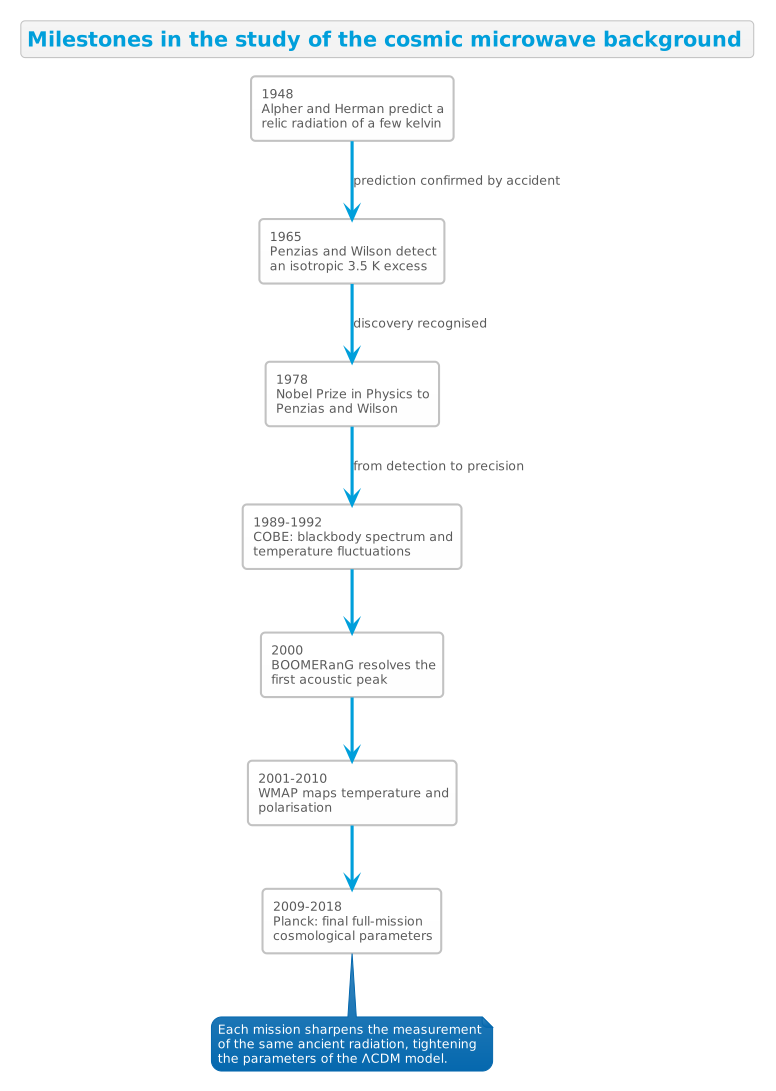
The idea that the universe began in a hot, dense state was developed in the 1940s by George Gamow and his collaborators, who realised that a universe that was once enormously hot should still be filled with the radiation left over from that era, cooled by the expansion to a temperature of a few kelvin. In 1948, Ralph Asher Alpher and Robert Herman estimated the temperature of this relic radiation and obtained a value of a few kelvin, remarkably close to the value measured seventeen years later.[3] The prediction attracted little attention at the time, and the radiation was not searched for observationally.
The idea was independently revived in the early 1960s. Robert H. Dicke and his group at Princeton University reasoned that the universe must be filled with a relic radiation of a few kelvin, and began building a small radiometer to look for it at a wavelength of about 3 centimetres. The detection, however, came first, and from an unexpected quarter.
Accidental discovery (1964–1965)

In 1964 and 1965, Arno Penzias and Robert Woodrow Wilson were using a 20-foot horn-reflector antenna in Holmdel, New Jersey, built for satellite communications, to measure the faint radio emission of the Milky Way. At a wavelength of 7.35 centimetres (a frequency of 4080 megacycles per second), they found an excess antenna temperature of about 3.5 kelvin that was isotropic, unpolarised, and present at all times of day and year, whatever part of the sky the antenna pointed at.[2] They eliminated every source of noise they could think of, even removing a pair of pigeons that had taken up residence in the antenna throat and cleaning away the "white dielectric material" they had left behind, yet the excess remained.
Penzias and Wilson reported the measurement in a short paper, "A Measurement of Excess Antenna Temperature at 4080 Mc/s", published in 1965 in The Astrophysical Journal.[2] Almost simultaneously, and in the same issue of the journal, Dicke's group published the companion paper interpreting the excess as the relic radiation of the Big Bang, which they had been about to search for. The two groups had been in contact: when Dicke heard of the Bell Labs result, he is said to have told his colleagues, "Well, boys, we've been scooped." The radiation became known as the cosmic microwave background.
Arno Penzias and Robert Woodrow Wilson shared the 1978 Nobel Prize in Physics for their discovery.
COBE: the spectrum and the fluctuations
The next decisive step came with NASA's Cosmic Background Explorer (COBE) satellite, launched in November 1989, which carried three instruments designed to study the radiation. The Far-Infrared Absolute Spectrophotometer (FIRAS), led by John C. Mather, compared the CMB with an internal blackbody calibrator and showed that its spectrum is that of a near-perfect blackbody, with no deviations detectable at the level of about one part in 10,000 of the peak brightness.[4] The Differential Microwave Radiometer (DMR), led by George F. Smoot, searched for spatial variations in the temperature; in April 1992 the team announced the detection of the long-sought temperature fluctuations, at the level of about one part in 100,000.[5]
The COBE results transformed the study of the CMB: the measurement of a perfect blackbody spectrum confirmed that the radiation is a relic of a hot, dense, thermalised early universe, while the detection of fluctuations showed that the early universe was not perfectly smooth, providing the seeds from which galaxies and clusters later grew. John C. Mather and George F. Smoot shared the 2006 Nobel Prize in Physics for these measurements.
WMAP and Planck
.jpg)
Two subsequent space missions mapped the CMB with far higher sensitivity and resolution. NASA's Wilkinson Microwave Anisotropy Probe (WMAP), launched in 2001, and its successor, ESA's Planck satellite, launched in 2009, measured the temperature and polarisation of the CMB across the whole sky. The final full-mission Planck results, published in 2020, determined the parameters of the standard cosmological model to percent-level precision, measuring the age of the universe at 13.787 billion years, the Hubble constant at 67.4 km s−1 Mpc−1, and the tilt of the primordial fluctuation spectrum at about 0.965, all consistent with a spatially flat universe dominated by dark energy and dark matter.[1]
Origin and physical properties
The surface of last scattering
In the hot early universe, matter was ionised: free protons and electrons formed a plasma that scattered light almost continuously, so that radiation and matter were tightly coupled and the universe was opaque. As the universe expanded, it cooled, until, a few hundred thousand years after the Big Bang, its temperature had fallen to about 3000 kelvin and the free electrons combined with protons to form neutral hydrogen, in the epoch known as recombination. With the charged particles gone, the radiation was suddenly free to travel: the universe became transparent, and the photons that had been scattered for the last time began to stream freely. Those photons are the cosmic microwave background we observe today.
The region from which these photons reach us is called the surface of last scattering. It is not a physical surface but a spherical shell centred on the observer, at a redshift of about 1090, corresponding to a time when the universe was about 380,000 years old and roughly one-thousandth of its present size.[1] Since decoupling, the expansion of the universe has stretched the wavelength of each photon by a factor of (1 + z), so that the temperature of the radiation scales with redshift as
where T0 ≈ 2.7 K is the temperature measured today. Between emission and reception, the CMB photons have travelled almost freely, deflected only slightly by the gravity of intervening matter, an effect known as gravitational lensing.
A near-perfect blackbody
.svg)
A blackbody is an ideal emitter that radiates purely according to its temperature. The spectrum of the cosmic microwave background matches the Planck function, the theoretical spectrum of a blackbody, to extraordinary precision: FIRAS measured it across more than a decade of the spectrum and found the data to be indistinguishable from a blackbody curve, placing tight limits on any deviation.[4] In terms of frequency ν, the intensity of a blackbody at temperature T is given by Planck's law:
where h is the Planck constant, c the speed of light, and kB the Boltzmann constant. The temperature of the CMB monopole, the sky-averaged value of the radiation, is about 2.7 K, and its spectrum peaks at a wavelength set by Wien's displacement law:
For T ≈ 2.7 K this gives a peak wavelength of roughly a millimetre, squarely in the microwave band, which is why the radiation is observed with microwave instruments.
That the CMB is such a precise blackbody is powerful evidence for the hot Big Bang theory. Only radiation that was once in thermal equilibrium with matter in an extremely hot, dense phase can plausibly fill the sky with a blackbody spectrum to this accuracy; steady-state cosmologies, in which the radiation would have to be produced by astrophysical sources, have no natural way of generating it.[4]
A geometric probe of the universe

The pattern of the CMB also makes it a precise probe of the geometry of the universe. Cosmologists describe densities in terms of the critical density, the density that would just halt the expansion of a spatially flat universe:
where H is the Hubble parameter and G the gravitational constant. The ratio of any component's density to the critical density is its density parameter, and the total density parameter of the universe is usually written Ωtotal. The angular scale of the acoustic peaks of the CMB (described below) depends on the total density: in a positively curved universe, features would appear larger than in a flat one, and in a negatively curved universe they would appear smaller. The Planck measurements of the peaks imply a total density parameter of 1 to within a few tenths of a percent, and a curvature density parameter ΩK = 0.0007 ± 0.0019: the universe is spatially flat to very high precision.[1]
Flatness alone does not fix the composition, but the detailed shape of the CMB pattern does. Planck finds that ordinary baryonic matter contributes about 5% of the total density, dark matter about 27%, and dark energy about 68%, with the dark energy behaving like a cosmological constant.[1] These are the values quoted in the articles on dark energy and dark matter, which the CMB constrains jointly with the other cosmological probes.
The anisotropy of the CMB
The dipole

The largest apparent departure from uniformity of the CMB is a dipole: the sky is very slightly hotter in one direction and colder in the opposite one, by about one part in a thousand, a temperature difference of a few millikelvin. The dipole does not originate in the early universe but in our own motion: the Solar System is moving at a few hundred kilometres per second relative to the rest frame defined by the CMB, and the resulting Doppler shift makes the radiation slightly hotter in the direction of motion and colder behind us.[5] Removing this dipole is the first step in analysing the CMB, and it leaves a pattern that is uniform to one part in 100,000.
Fluctuations of one part in 100,000
After the dipole is subtracted, the CMB temperature is almost perfectly constant across the sky: the remaining fluctuations, first detected by COBE in 1992, are at the level of about 30 microkelvin, one part in 100,000 of the mean.[5] These fluctuations are the imprint of tiny density variations present in the universe at recombination, the "seeds" from which galaxies, clusters and the large-scale structure of the cosmos later grew by gravitational instability: slightly overdense regions had slightly hotter radiation and eventually collapsed into the structures seen today.
The pattern of the fluctuations is nearly scale-invariant, meaning that patches of very different angular size have comparable amplitude, as predicted by the theory of cosmic inflation. The statistics of the pattern are described by expanding the temperature map into spherical harmonics, each labelled by a multipole ℓ that roughly corresponds to an angular scale of 180°/ℓ.
The angular power spectrum
.svg)
The statistical content of the fluctuations is usually summarised by the angular power spectrum, the variance of the spherical-harmonic coefficients Cℓ as a function of multipole ℓ, conventionally plotted in the dimensionless form
The power spectrum of the CMB is not flat: it shows a series of peaks and troughs, the acoustic peaks, which are among the most important measurements in cosmology. They arise because, before recombination, the photon–baryon fluid supported sound waves: gravity compressed overdense regions while radiation pressure pushed back, setting up oscillations that froze into the temperature pattern when the radiation decoupled. Modes that had completed a whole number of half-oscillations by decoupling appear as peaks in the power spectrum, and modes caught at other phases appear as troughs.
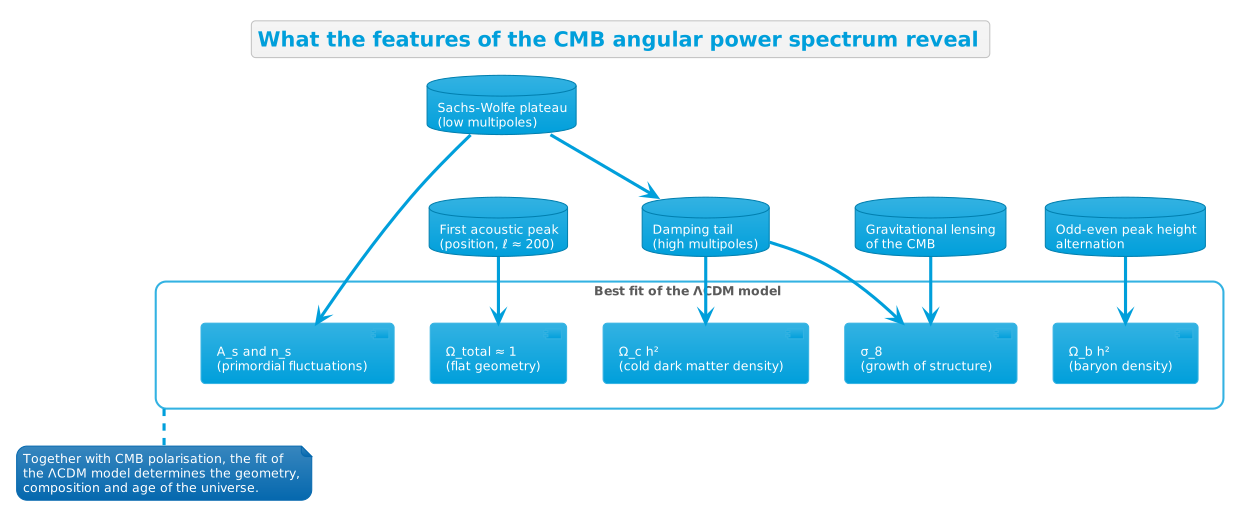
Each feature of the power spectrum carries specific information:
- the position of the first peak, at ℓ ≈ 200, is set by the angular size of the sound horizon and measures the total density of the universe, pinning down its geometry;[1]
- the odd–even alternation in the heights of successive peaks, the pattern of compressional versus rarefactional modes, measures the baryon density, since baryons load the compressional modes;
- the overall damping of the peaks at high ℓ, caused by photons diffusing out of small regions during recombination (Silk damping), measures the matter density and the thickness of the last scattering surface;
- the plateau of power at low ℓ, the Sachs–Wolfe effect, reflects the gravitational potential fluctuations and measures the amplitude and tilt of the primordial fluctuation spectrum;
- gravitational lensing of the CMB by intervening matter slightly smooths the peaks and adds power at small scales, providing a direct measurement of the growth of structure, sensitive to dark matter.
Fitting the full spectrum together with the polarisation measurements and the lensing signal yields the parameters of the standard model of cosmology, and it is in this way that the CMB constrains the geometry, contents and age of the universe quoted above.[1]
Polarisation
The CMB is also faintly polarised, at the level of a few microkelvin, because the last scattering of the photons was not isotropic: the quadrupolar pattern of the incoming radiation around each scattering electron imprinted a preferred direction on the scattered light. The polarisation pattern can be decomposed into a curl-free component (E-modes), generated by the same density fluctuations that produce the temperature anisotropies, and a divergence-free component (B-modes), which density fluctuations cannot generate at first order.
A primordial B-mode signal would be the signature of gravitational waves generated during cosmic inflation, stretched to cosmological scales by the rapid expansion. Its detection would directly probe the energy scale of inflation. So far, searches combining Planck data with ground-based and balloon-borne experiments such as BICEP/Keck have found no convincing primordial B-mode signal, and instead measure the E-mode pattern precisely and the lensing-induced B-modes, continuing to tighten the constraints on the standard model.[1]
Significance
The cosmic microwave background underpins the modern cosmological model in several distinct ways. Its near-perfect blackbody spectrum is the direct observational evidence that the universe went through a hot, dense, radiation-dominated phase, and it rules out cosmologies without such a phase.[4] Its temperature fluctuations provide the initial conditions for the growth of all cosmic structure, from galaxies to the cosmic web, and confirm that those fluctuations were nearly scale-invariant, as inflation predicts.[1] Its acoustic peaks provide a "standard ruler" of known physical length, the sound horizon at recombination, whose apparent size at different distances anchors the baryon acoustic oscillation measurements used to trace the expansion history of the universe and to probe dark energy.[1] And its measurement of the geometry and contents of the universe, together with the independent supernova and large-scale-structure evidence, establishes the cosmic energy budget: a spatially flat universe whose energy is dominated by dark energy and dark matter, with ordinary matter a minor ingredient.[1]
For these reasons the CMB is, as of September 2026, one of the most active frontiers of observational cosmology. Current and planned experiments continue to map its polarisation at ever higher sensitivity: ground-based instruments such as the Simons Observatory and CMB-S4, and the proposed space missions such as JAXA's LiteBIRD, aim primarily at the search for the primordial B-modes that would reveal the physics of inflation.
References
- ↑ ↑ ↑ ↑ ↑ ↑ ↑ ↑ ↑ ↑ ↑ ↑ Planck Collaboration. (2020). Planck 2018 results (Scholarly article). In Astronomy and Astrophysics (Vols. 641, p. A6). https://doi.org/10.1051/0004-6361/201833910
- ↑ ↑ ↑ Penzias, A. (1965). A Measurement of Excess Antenna Temperature at 4080 Mc/s (Scholarly article). In The Astrophysical Journal (Vols. 142, Issue 1, pp. 419–421). https://doi.org/10.1086/148307
- ↑ Alpher, R. A. (1948). On the Relative Abundance of the Elements (Scholarly article). In Physical Review (Vols. 74). https://doi.org/10.1103/PhysRev.74.1737
- ↑ ↑ ↑ ↑ Mather, J. C. (2007). Nobel Lecture: From the Big Bang to the Nobel Prize and beyond (Scholarly article). In Reviews of Modern Physics (Vols. 79, Issues 4, pp. 1331–1348). https://doi.org/10.1103/RevModPhys.79.1331
- ↑ ↑ ↑ Smoot, G. F. (2007). Nobel Lecture: Cosmic microwave background radiation anisotropies: Their discovery and utilization (Scholarly article). In Reviews of Modern Physics (Vols. 79, Issues 4, pp. 1349–1379). https://doi.org/10.1103/RevModPhys.79.1349
Further reading
- The Universe, NASA Science
- Wilkinson Microwave Anisotropy Probe, NASA
- Planck, European Space Agency
- Planck 2018 results. VI. Cosmological parameters, Planck Collaboration (2020)