HowItWorks:MediaWiki: Difference between revisions
| Line 145: | Line 145: | ||
== MediaWiki in action == | == MediaWiki in action == | ||
Core MediaWiki functionality reduces to two flows: '''reading''' a page and '''writing''' one. Both go through the same machinery. | |||
=== Page view === | === Page view === | ||
<uml> | |||
@startuml | |||
!theme bluegray | |||
title Page View Flow | |||
|#LightGray|Client| | |||
start | |||
:Request page; | |||
|#LightBlue|Web Server| | |||
:Resolve title\n(check permissions); | |||
|#LightGreen|Cache| | |||
:Look up rendered\nHTML in cache; | |||
if (cache exist?) then (yes) | |||
if (cache_timestamp > last_edit_timestamp?) then (yes) | |||
:Retrieve cached HTML; | |||
|#LightGray|Client| | |||
:Serve cached page; | |||
stop | |||
else (no) | |||
|#LightGreen|Cache| | |||
:Purge cache; | |||
endif | |||
else (no) | |||
endif | |||
|#LightYellow|Database| | |||
:Load raw wikitext; | |||
|#LightPink|Parser| | |||
:Preprocess + Convert\nto HTML (Sanitizer); | |||
|#LightBlue|Web Server| | |||
:Apply Skin & assets; | |||
fork | |||
|#LightGreen|Cache| | |||
:Store rendered output\nto cache for future; | |||
fork again | |||
|#LightGray|Client| | |||
:Serve fresh page; | |||
end fork | |||
stop | |||
@enduml | |||
</uml> | |||
=== Page edit === | === Page edit === | ||
<uml> | |||
@startuml | |||
!theme bluegray | |||
title Page Edit Flow | |||
|#LightGray|Client| | |||
start | |||
:Open edit form\n(load wikitext); | |||
repeat | |||
:Modify wikitext; | |||
if (Preview / Diff?) then (yes) | |||
:Show preview/diff\n(without saving); | |||
else (no) | |||
endif | |||
repeat while (Continue editing?) is (yes) -> no | |||
:Submit save; | |||
|#LightBlue|Web Server| | |||
:Check edit conflict\n(compare revisions); | |||
if (Conflict detected?) then (yes) | |||
|#LightGray|Client| | |||
:Show merge screen\n(auto-merge unrelated sections); | |||
:Merge & resubmit; | |||
|#LightBlue|Web Server| | |||
:Re-check (no conflict); | |||
else (no) | |||
endif | |||
|#LightYellow|Database| | |||
fork | |||
:Store new revision\n(author, time, summary); | |||
fork again | |||
:Update page history\nand RecentChanges; | |||
end fork | |||
|#LightGray|Client| | |||
:Edit complete\n(page updated); | |||
stop | |||
@enduml | |||
</uml> | |||
== Key design decisions == | == Key design decisions == | ||
Revision as of 16:18, 28 August 2026
Explains how things actually work — part of our technology dissections collection.
MediaWiki is the free, open-source wiki engine behind thousands of wiki instances, such as Wikipedia, Wikidata — and this very site: RonzzWikiBase [5].
What is a wiki engine?
Wiki engine is the software behind a wiki: a website hosting static pages, usually informative, which contributors can edit within their browser, with every change tracked and reversible, hence allowing contributions from a large number of editors located anywhere in the world. In its most radical form, e.g., Wikipedia, anyone reading the page can make edits, quickly correcting errors and updating pages.
A wiki engine's job is to store wiki pages in a database, and pull them up for contributors to edit or for the renderer to render page to HTML for readers.
MediaWiki, one of the most well-known wiki engines, was originally built as a summer project by early Wikipedia contributor Magnus Manske in 2001 to support a growing Wikipedia. It went through multiple full/partial rewrites to reach 1.0 release maturity in December 2004, and it is today used by tens of thousands of wikis, private and public.
Components and interactions
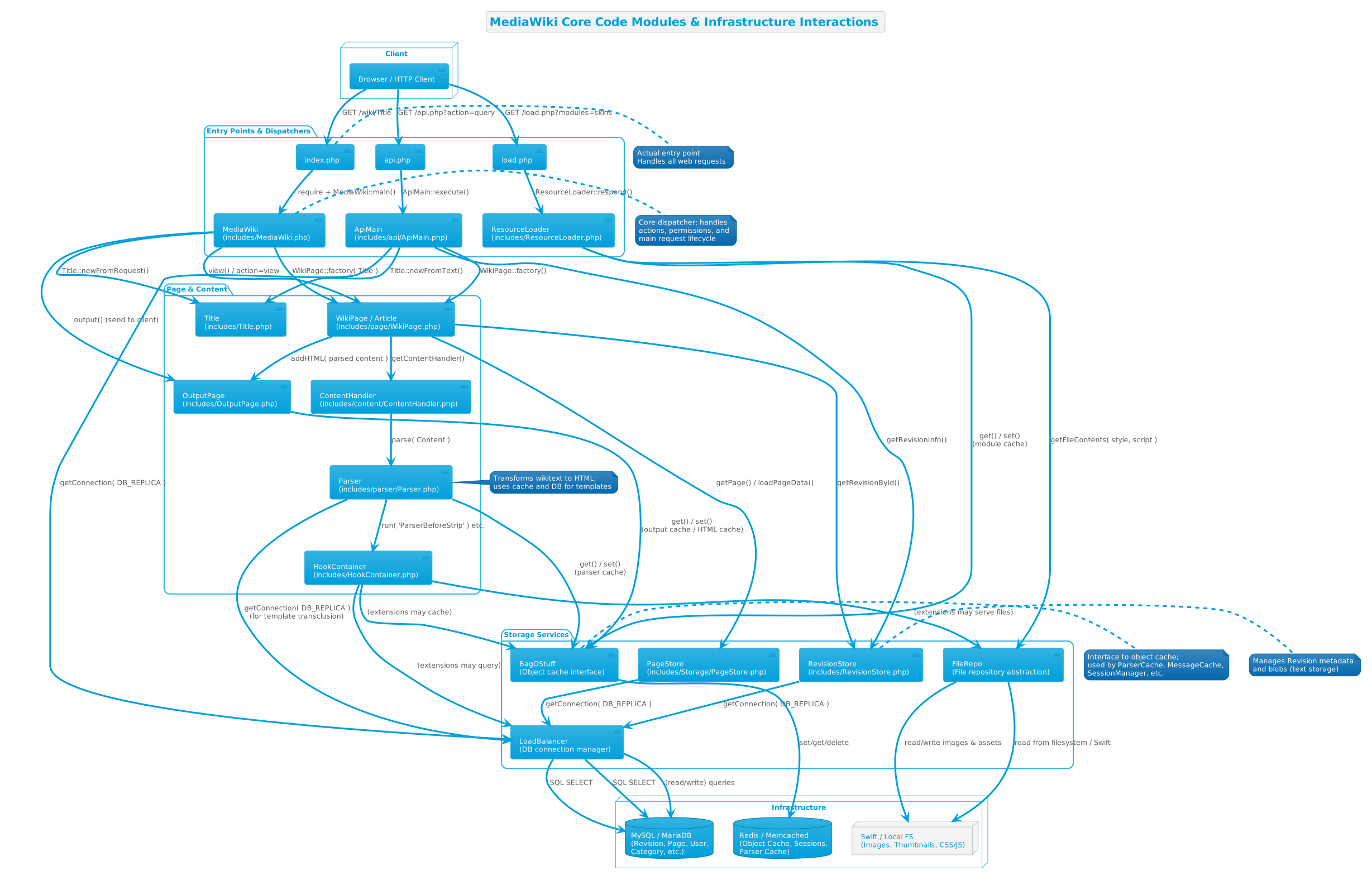
MediaWiki in action
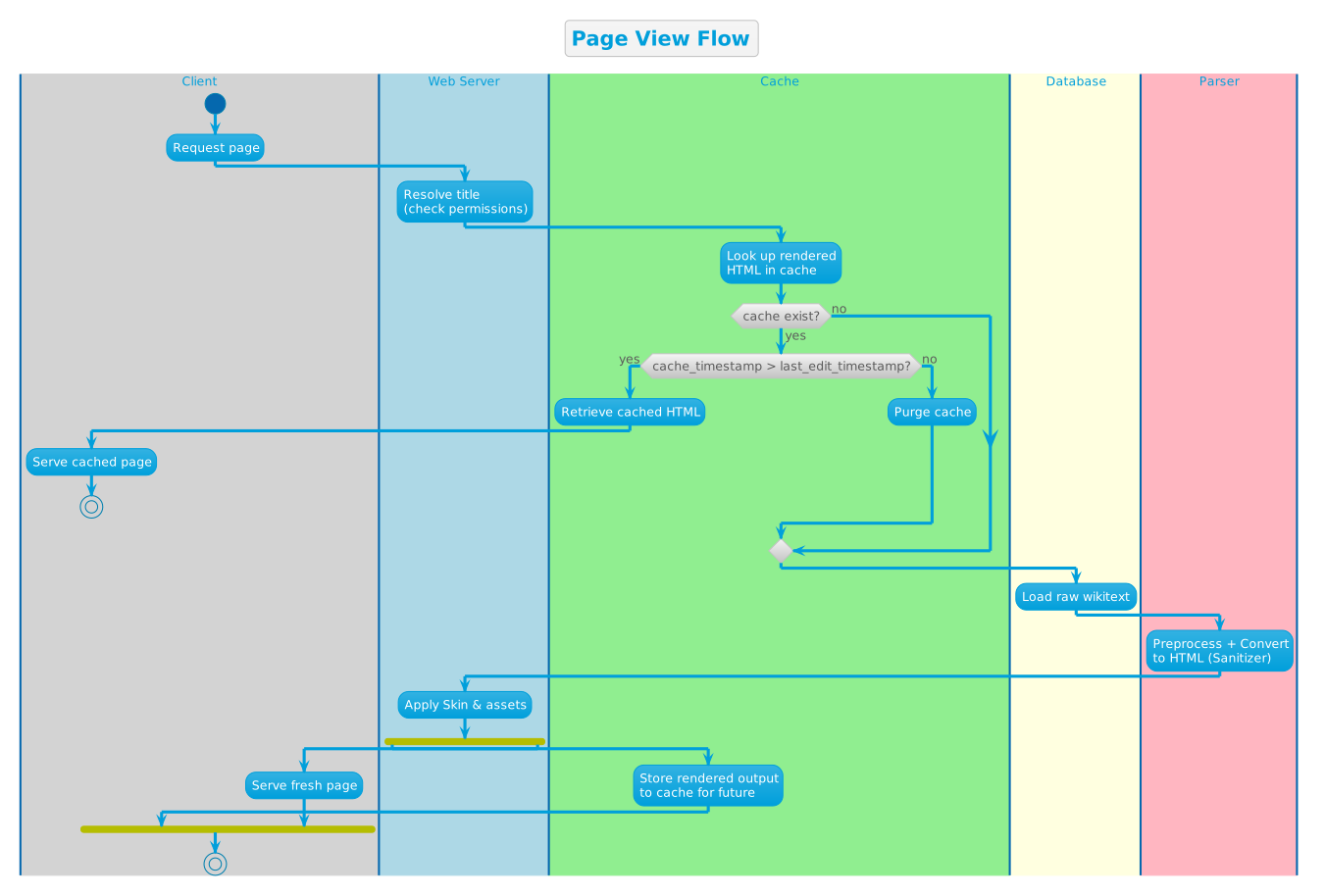
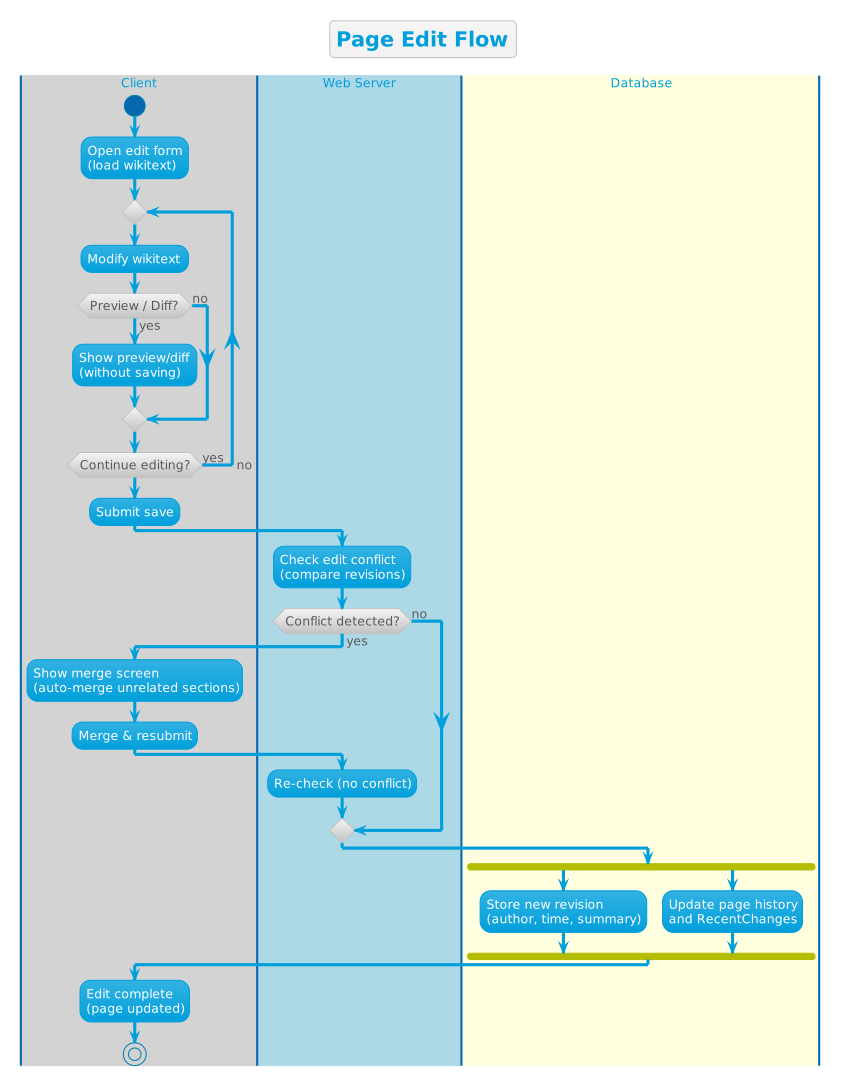
Core MediaWiki functionality reduces to two flows: reading a page and writing one. Both go through the same machinery.
Page view
Page edit
Key design decisions
Six choices explain why MediaWiki behaves the way it does. None is obvious; each trades a little simplicity for a lot of power.
Content stays in wikitext, not HTML
MediaWiki stores pages as wikitext — a lightweight markup — and renders it to HTML only when a page is displayed [1]. Editors edit the source, and the source is what is stored.
Why does that matter?
- Editing stays easy. Wikitext is plain text a human can read and write; raw HTML is verbose and error-prone [1].
- The wiki stays re-renderable. Because the source is kept, the whole wiki can be re-parsed when the parser improves, a skin changes or a template is fixed. Nothing is ever frozen as HTML [1].
- History stays cheap. Every revision is stored as text, so any old version can be re-parsed and re-displayed — that is what makes diffs, rollback and undo work [1].
The parser is a stability contract
The parser turns wikitext into HTML, and MediaWiki treats its output as a promise: hundreds of millions of pages depend on it, so it changes slowly and conservatively [1].
The price is that wikitext never received a formal specification. It grew organically from the markup of an earlier engine, UseModWiki, so it cannot be described by a formal grammar — the unofficial spec is "whatever the parser spits out, plus a few hundred test cases" [1].
The clever part is how MediaWiki handles that constraint: it is building a second parser, Parsoid, alongside the classic one. Parsoid converts wikitext to HTML and back, which is what powers the visual editor [1].
Templates are DRY for wikis
Templates let a wiki define something once and reuse it everywhere — a navigation box, a banner, an infobox. A page calls a template with {{Name}}, and its content is expanded into the page at read time [1].
For Wikipedia this was transformative: the same boilerplate used to be copied onto thousands of articles. Templates gained parameters in MediaWiki 1.3 and default values in 1.6, and users pushed them hard — building near-programming constructs with the {{#if:…}} and {{#switch:…}} parser functions [1].
The price was performance: template-heavy pages became slow to parse. MediaWiki's answer was a rewritten preprocessor in MediaWiki 1.12 (2008): it parses templates into a tree and skips the branches that are never used, such as the un-taken cases of a #switch [1][7]. Template-heavy pages got much faster, without any change to the markup.
Skins separate content from presentation
A skin is the frame around the content: the header, footer and sidebar, plus the CSS and JavaScript that style them [3]. The parsed content HTML is the same under every skin; the skin decides how it is wrapped and presented.
The consequence is elegant: re-skinning a site never touches the content. Readers choose their skin in their preferences — the default is Vector [3] — and this very site offers both Vector and Timeless [2]. The same parsed page renders under either, without re-parsing [1].
Extensions plug in; the core stays stable
MediaWiki's core is deliberately small; almost everything extra lives in extensions. They attach to the core through hooks — places where third-party code can run before, after, or instead of MediaWiki's own behaviour for a given event [1]. Some hooks even let an extension add new wikitext syntax of its own [1].
This was not always so. Before hooks arrived in 2004, customising MediaWiki meant editing the core — fragile and hard to maintain [1]. The hook system turned that into a supported plug-in mechanism.
On this very site the pattern is visible: Cite, SyntaxHighlight, Wikibase — and Ronzz's own EmbeddableContent and WikibaseCitation — are all extensions, not forks [2].
Caching is the price of PHP
Every request boots PHP from scratch, so a busy wiki would be slow without help. MediaWiki answers with layers of caches [1]:
| Layer | What it stores | Effect |
|---|---|---|
| Reverse proxy (CDN) | whole rendered pages | serves anonymous readers without booting PHP at all; most requests never reach the application servers [1] |
| Object cache (Memcached / Redis) | parsed page output | avoids re-parsing the same wikitext [1] |
| Opcode cache | compiled PHP | skips recompiling scripts on every request [1] |
The clever part is that MediaWiki does not merely sit behind these caches — it tells them what to forget. When a page changes, MediaWiki purges it from the caches; when a template changes, every page that uses it is invalidated [1]. Correct invalidation is the hard part, and getting it right is what lets a constantly-edited site like Wikipedia be served from cache.
Try it yourself
All commands below were verified to work at the time of writing (2026-08-28) against this wiki (MediaWiki 1.46.0 [2]).
# Which version is this wiki running?
curl -s "https://wikibase.ronzz.org/api.php?action=query&meta=siteinfo&siprop=general&format=json" | grep -o '"generator":"[^"]*"'
Output:
"generator":"MediaWiki 1.46.0"
# See the parser's HTML output for a page (the raw pipeline result, before the skin)
curl -s "https://wikibase.ronzz.org/api.php?action=parse&page=Main_Page&format=json" | grep -o "<p><strong>[^<]*"
Output:
<p><strong>Hi, welcome to ronzz.ORG's wikibase.
# Preview without saving: run a snippet of wikitext through the parser
curl -sG "https://wikibase.ronzz.org/api.php" --data-urlencode "action=parse" --data-urlencode "text='''Bold''' and ''italic''" --data-urlencode "format=json" | grep -o "<b>.*</i>"
Output:
<b>Bold</b> and <i>italic</i>
# Every edit leaves a trace: the last three revisions of Main Page
curl -s "https://wikibase.ronzz.org/api.php?action=query&prop=revisions&titles=Main_Page&rvprop=timestamp%7Cuser&rvlimit=3&format=json" | grep -oE '"user":"[^"]*"|"timestamp":"[^"]*"'
Output:
"user":"Rongzhou"
"timestamp":"2026-08-24T14:55:13Z"
"user":"Rongzhou"
"timestamp":"2026-08-21T06:08:37Z"
"user":"Rongzhou"
"timestamp":"2026-08-19T18:59:55Z"
See the preprocessor stage directly: Visit Special:ExpandTemplates
- paste
{{HowItWorks}}into the input box and click "Expand" — - you see the expanded wikitext, before the parser turns it into HTML.
References
- Manual:MediaWiki architecture — the architecture deep-dive on mediawiki.org
- This wiki's siteinfo API — version, PHP and database, extension list (fetched 2026-08-28)
- Manual:Skins — skins documentation
- Help:Editing pages — user documentation for editing
- MediaWiki — the software project page
- Help:Edit conflict — how conflicts are detected and resolved
- Release notes/1.12 — the preprocessor rewrite
- Revisions query (ids|timestamp|user|comment) — verified 2026-08-28
- Parse API for Main Page — verified 2026-08-28
- Parse API with raw text — verified 2026-08-28
- Revisions query (timestamp|user) — verified 2026-08-28
Further reading
- Manual:MediaWiki architecture — the canonical architecture deep-dive (also a chapter of the Architecture of Open Source Applications book)
- Manual:Contents — the technical manual of the software
- MediaWiki — the software project page
The reference layer for this site's own data lives in the SPARQL cheatsheet: the sheet is the syntax, this page is the machinery.
Wiki: wikibase.ronzz.org