Set
A set is an unordered collection of distinct elements.[1]
Formal definition
According to Morse-Kelley set theory:
$$ \exists B: A \in B \iff A \text{ is a set} $$
Defining a set
Enumeration
A small finite set can be described by enumerating all its elements:
$$ S=\{\text{Apple, Banana, Peaches}\} $$
Some infinite sets following simple patterns can also be enumerated:
$$ S=\{0,1,2,\cdots\} \text{ (Set of natural numbers)} $$
To avoid ambiguity, reserve enumeration for simple patterns that most people can identify at first glance. Use #Set-builder notation elsewise.
Set-builder notation
A set that cannot be easily described by enumeration can often be described by rules that all elements of the set follow.
e.g.,
$$ S=\{x | x = 2^n, n \in N\ \land n \le 20\} $$
is the infinite set of all natural number powers of 2 up to $2^20$: 2,4,8,16,32,64,128,256...
Special sets
| Set | Symbol | Note |
|---|---|---|
| Empty set | $\emptyset$ | |
| Universal set | $U$ | Set of all elements relevant to a particular context |
Set properties
Cardinality
The cardinality of a set $S$, denoted $|S|$, is its number of elements.
Example:
| $S$ | $|S|$ |
|---|---|
| $\{1,2,3\}$ | 3 |
| $\{a,b,c,\cdots,z\}$ | 26 |
| $\{0,2,4,6,8,\cdots\}$ | $\infty$ |
In everyday language, "size" is often used as an alternative term for cardinality.
Set relationships
Complement
Let $A$ be a set.
$$ x \in A^c \iff x \in U \land x \notin A \text{ (absolute complement)} $$
Intersection, union, symmetric difference
Let $A$, $B$ be sets.
$$\begin{gathered} x \in A \cap B \iff x \in A \land x \in B \text{ (intersection)} \\ x \in A\cup B \iff x \in A \lor x \in B \text{ (union)} \\ x \in A\triangle B \iff x \in A \oplus x \in B \text{ (symmetric difference)} \end{gathered}$$
If $A \cap B = \emptyset$, $A,B$ are said to be disjoint.
-
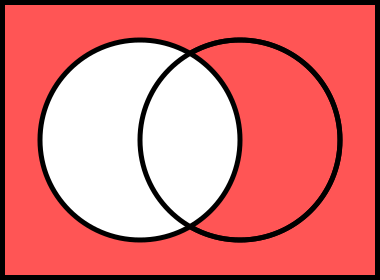 $A^c$
$A^c$ -
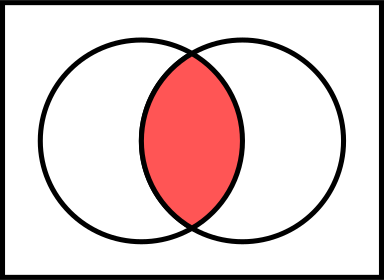 $A \cap B$
 -
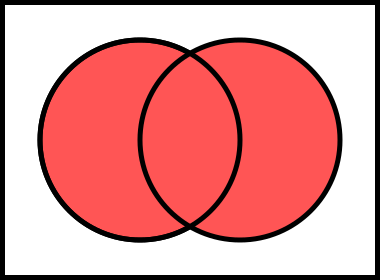 $A \cup B$
 -
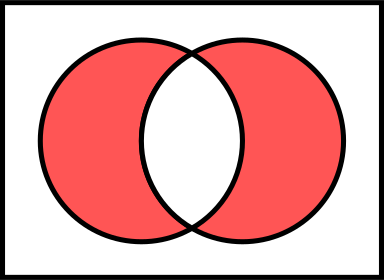 $A \triangle B$


Diagrams like this that visualise sets as circles and represent their relationship via relative positions are called Venn diagrams.
Subset
Let $A$, $B$ be sets.
$$\begin{gathered} A \subseteq B \iff \forall x \in A: x \in B \text{ (subset)} \\ A \subset B \iff (A \subseteq B) \land (A \neq B) \text{ (proper subset)} \end{gathered}$$
It can be therefore inferred:
$$\begin{gathered} A \not\subseteq B \iff \exists x \in A: x \notin B \\ A \subseteq A \\ \forall S: \emptyset \subseteq S \\ \end{gathered}$$
Direct product
Power set
Let $A$ be a set, $X$ be some sets.
If:
$$ \mathcal{P}(A) = \{X |\forall X \subseteq A\}. $$
Then
$\mathcal{P}(A)$ is the power set of $A$.
Note the power set $\mathcal{P}(A)$ is a set of sets.
Example:
$$ \mathcal{P}(\{a, b\})= \{\emptyset, \{a\}, \{b\}, \{a,b\}\}. $$
It can be inferred:
$$ |\mathcal{P}(S)|=2^{|S|} $$
Proof by induction:
Let $S_n:|S_n|=n$ be sets.
By definition of #cardinality, $n \in N$.
If $n=0$:
$$\begin{gathered} \mathcal{P}(S_0)=\{\emptyset\} \\ |\mathcal{P}(S_0)|=1=2^n \end{gathered}$$
If $n=1$:
$$\begin{gathered} \mathcal{P}(S_1)=\{\emptyset\,A\} \\ |\mathcal{P}(S_1)|=2=2^n \end{gathered}$$
If $n>1$:
Given $|\mathcal{P}(S_n)|=2^n$
For any set $S_{n+1}: |S_{n+1}|=n+1$, identify an arbitrary element $s\in S_{n+1}$, then
$$ S_{n+1}=S_n+s $$ where set $S_n:|S_n|=n$.
As $|\mathcal{P}(S_n)|=2^n$, $S_n$ has $2^n$ subsets: $A_1=\emptyset,A_2,A_3,...A_{m}$, where $m=2^n$
Since
$$ A_m \subseteq S_n \subset S_{n+1} \Rightarrow A_m \subset S_{n+1} $$
which gives $m$ subsets of $S_{n+1}$
and
$$\begin{gathered} \because s \in S_{n+1} \\ \therefore A_m+s \subseteq S_{n+1} \end{gathered}$$
which gives $m$ more subsets of $S_{n+1}$
Therefore, $S_{n+1}$ has $2m=2 \cdot 2^n=2^{n+1}$ subsets,
i.e.,$|\mathcal{P}(S_{n+1})|=2^{n+1}$
$\therefore $ By induction,
$$ |\mathcal{P}(S)|=2^{|S|} $$
- ↑ Sklar, J. K. (2026). 1.1: Sets. LibreTexts. https://math.libretexts.org/Bookshelves/Abstract_and_Geometric_Algebra/First-Semester_Abstract_Algebra%3A_A_Structural_Approach_(Sklar)/01%3A_Preliminaries/1.01%3A_Sets
- ↑ Kelly, J. L. (1955). General topology.
- ↑ Lippman, D. (2022). 2.1: Language of Sets. LibreTexts. https://math.libretexts.org/Courses/Las_Positas_College/Math_for_Liberal_Arts/02%3A_Set_Theory/2.01%3A_Language_of_Sets
- ↑ Sklar, J. K. (2026). 1.3: Cardinality. LibreTexts. https://math.libretexts.org/Bookshelves/Abstract_and_Geometric_Algebra/First-Semester_Abstract_Algebra%3A_A_Structural_Approach_(Sklar)/01%3A_Preliminaries/1.03%3A_Cardinality
- ↑ ↑ ↑ Sundstorm, T. (2021). 5.1: Sets and Operations on Sets. LibreTexts. https://math.libretexts.org/Courses/SUNY_Schenectady_County_Community_College/Discrete_Structures/05%3A_Set_Theory/5.01%3A_Sets_and_Operations_on_Sets